


The Route Creation Service (RCS) plugin allows you to interact with your running batch jobs through APIs (pyAnsys for example), or through web applications like the Ansys Fluent web app.
Purpose
High‑performance computing (HPC) environments often lack direct enterprise‑network routes to compute nodes, making it difficult for clients to know where to connect and creating challenges around secure certificate management.
RCS helps overcome these issues by creating secure, temporary routes to otherwise unreachable compute nodes and/or providing TLS termination at the network edge, removing the need for certificates on every compute node.
How it Works
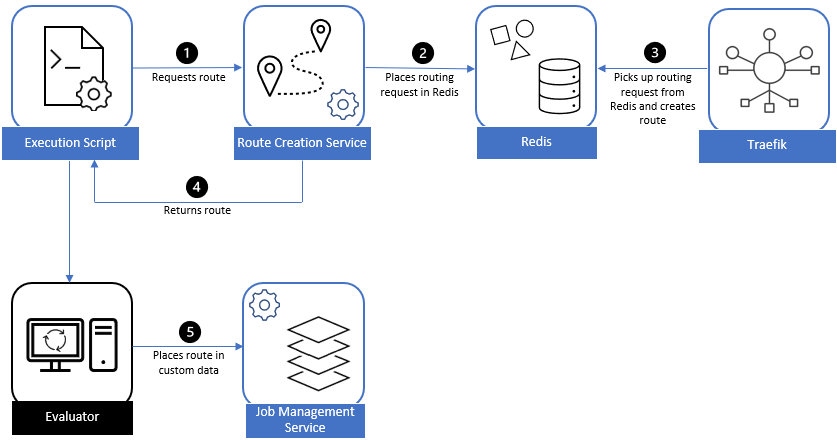
RCS is a plugin service that allows it to connect to a variety of pluggable backends that will provide routes. The beta version of RCS supports non-Kubernetes workflows that use Traefik (for secure networking) and Redis (for data store).
In this workflow, the execution script requests a route from RCS, which then uses the plugin to create the appropriate connection path. The execution script then writes the resulting connection location to the Job Management Service, allowing the client to retrieve that information and connect to the running job.
Security
RCS offers flexible configurations to balance security needs with ease of deployment.
The default setup with RCS chooses TLS termination at the edge. Accordingly, calls within the HPC cluster are transmitted using HTTP. This is a pragmatic choice to avoid requiring every compute node to generate certificates for web or API‑enabled workflows.