


Analyses using plastic materials may observe stress values that are significantly higher than the material's yield strength, even in regions that remain elastic.
In most cases, this behavior is not an analysis error but a postprocessing effect caused by stress extrapolation from integration points (Gauss points) to nodes. By default, the Motion solver uses the strain-stress reporting option. With this setting, strains and stresses are reported as follows (see Strain-Stress Report for Plasticity Materials in the Motion Theory Reference for more information):
If an element remains fully elastic, results at the integration points are extrapolated to the nodes.
If any portion of the element is plastic, integration point results are copied directly to the nodes (no extrapolation).
The extrapolation from the elastic side can produce excessively high stresses, even if the underlying integration point stresses are below the yield strength. To avoid this overestimation and to obtain stress values that are consistent with the integration points, the Plastic Report option should be changed to (see below). This setting copies the integration point results directly to the nodes.
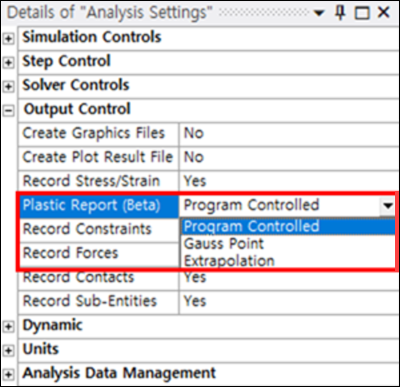
A comparison of the Equivalent Stress results using these two settings is shown below.
