


Dynamic positioning systems are equipped on many ships and offshore engineering systems for either manoeuvring in narrow places or maintaining a horizontal position. The PID (Proportional-Integral-Derivative) controller is a simple but powerful method of controlling ship course and floating structure dynamic positioning. The PID dynamic positioning force or moment is determined by
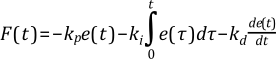 | (13–99) |
This scheme consists of three independent feedback controls: proportional, integral and derivative. The proportional control reduces the position error response to disturbances, which works the same as conventional spring stiffness. The steady state error can be eliminated by using the term related to the integral of the position error history. The derivative of the position error can be damped by the dynamic response term with the equivalent damping coefficient.
Low frequency motion responses are used in the PID control. The slow motion is estimated by Equation 13–32 in Aqwa-Drift, alternatively it is given by the Butterworth 2-pole low pass filter in Aqwa-Naut. To avoid unrealistic transient responses due to control forces at the initial period, the wave ramp function is used in the PID controlling force calculation.
You can define the maximum saturation limits of the PID controller's moment and the force components in the structural yaw slow motion local X-axis and Y-axis. If the moment or force components exceed the limit, the magnitudes of force and moment are reduced with the same scale at each time step.