


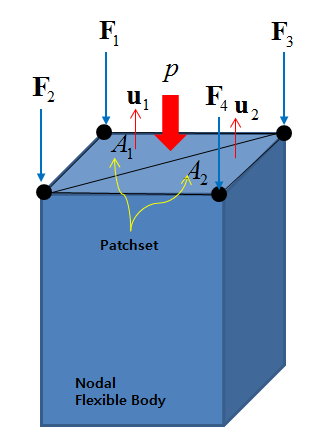
A Pressure Load represents single component pressure acting on a surface of a nodal flexible body.
The pressure defined by a Motion Function Expression or Pressure Load User Subroutine can be a function of displacement and velocity of the node itself, and time as in the following equation:
 | (4–75) |
where  is a pressure function on the specified surface. If the function
is dependent on acceleration, force, variables and displacement or velocity of
another bodies or nodes, the Motion solver can be numerically unstable.
is a pressure function on the specified surface. If the function
is dependent on acceleration, force, variables and displacement or velocity of
another bodies or nodes, the Motion solver can be numerically unstable.
A force on a patch can be determined from the following equation:
 | (4–76) |
where  and
and  are the area and normal direction of patch, respectively.
The sign of  can be determined by a switch option. If the outward direction of
the patch is selected, the sign has a value of 1. If the inward direction of the
patch is selected, the sign has a value of -1. For the example, in the figure above
the inward direction is selected.
can be determined by a switch option. If the outward direction of
the patch is selected, the sign has a value of 1. If the inward direction of the
patch is selected, the sign has a value of -1. For the example, in the figure above
the inward direction is selected.
The force acting on a node belonging to the patch can be calculated using the following equation:
 | (4–77) |
where  is the number of nodes belonging to the patch.
The total force acting on a node can therefore be calculated as follows:
 | (4–78) |
where  is the number of patches including the node.
The magnitude of the force acting on the patchset can be calculated from the following equation:
 | (4–79) |
where  is the number of patches in the patchset.