LS-DYNA provides two types of ALE solvers:
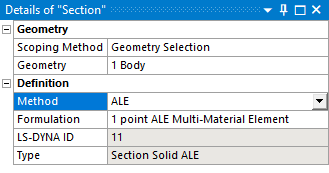
The unstructured ALE solver, which can be defined within Mechanical by assigning an ALE Method type. The unstructured mesh is created within Mechanical and is passed directly to the solver.
The structured ALE (S-ALE) solver can be invoked by creating a body with rectilinear box geometry and a Reference Frame set to S-ALE Domain. The default material for the domain is associated directly with the body. Additional bodies with Reference Frame set to S-ALE Fill, are filled into the S-ALE Domain. This is achieved by first meshing the S-ALE Fill bodies using the standard Mechanical meshing process. The surface meshes of these bodies are passed to the solver as dummy rigid shell bodies and are used to define the material with the S-ALE Domain. Once the filling is complete, the dummy rigid shell bodies have no further effect on the simulation. For more information, see the Initial Volume Fraction Geometry keyword.
The S-ALE Mesh Object is used to define mesh parameters and view the surface mesh for the S-ALE mesh that will be created within the solver.
Several objects are available for use in the ALE workflow:
The Coupling object which is added under connections, enables the setup of ALE-Lagrange interactions.
The ALE Boundary Object allows you to define stick and slip boundary conditions on the external faces of the ALE domain.
Note:
The mesh created within Mechanical is not directly used for the S-ALE domain. By default, the bounding box of the geometry and the number of elements generated by the Mechanical meshing process are used as parameters to define the size and density of a uniform rectilinear mesh that will be created by the solver. Further details are given in S-ALE Mesh.
Results for S-ALE bodies are not displayed on the original mesh. Instead, a mesh is reconstructed for each material associated with the original body to which the result object is scoped.
The reconstruction of the mesh is approximate and includes:
Finding the exterior surface of each material in its current location in the S-ALE domain. This is achieved by forming an isosurface on the volume fraction of each material in a cell (at 50%).
Filling the interior of the material with cells from the S-ALE domain that are completely inside the material.
Reconstructing an unstructured mesh for any gaps between the exterior surface and interior cells.
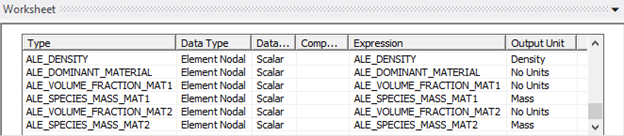
When ALE bodies are included in the model, several ALE-specific result variables are available as user defined variables: Density, Volume Fraction, Dominant Material, and Species Mass.