


ISO/TS 20065
Tonal audibility ISO/TS 20065 (dB) is based on the ISO/TS 20065:2022 standard. The standard describes a method to objectively determine noise tonality for the evaluation of tonal emissions.
ISO/TS 20065 is basically the same as DIN45681. Additionally, in the 2017 version of ISO1996-2, tonality is now in Annex J, and refers directly to ISO/PAS 20065, which was a preliminary version of ISO/TS 20065:2022. Here is a list of the differences between ISO/TS 20065 and DIN 45681:
- DIN 45681 outputs a Tonal adjustment Kt, meant to be used as a dBA penalty when the sound has tonal components, whereas ISO/TS 20065 does not.
- DIN 45681 can detect tones down to 90 Hz, whereas this limit was extended to 50 Hz in ISO/TS 20065. This means that a very low frequency tone (that is, between 50 and 90 Hz) can be detected by ISO/TS 20065, but will most likely be missed by DIN45681.
- Some minor changes, such as in the calculation of the detected tones’ edge slopes.
The standard is intended to augment the usual method for evaluation on the basis of aural impression, in particular cases in which there is no agreement on the degree of tonality. You can use this method if the frequency of the tone being evaluated is equal to, or greater than, 50 Hz. Analysis of frequency components in the measurement signals is performed using a frequency analyzer. The constant line spacing ∆f should lie in the range 1.9Hz to 4 Hz (inclusive). The use of the Hanning Window is required by this standard.
The method's details are presented below:
The method is the same for stationary and non-stationary noises. For tones that can only just be perceived, adopt a quaver (eighth note) as a base time that is adequate for hearing. However, comprehensive studies have shown that the lower limit for use of the method is reached at averaging times of approximately three seconds. Lower averaging times lead to unjustified tonal adjustment (too high, but also too low). Signals that have a high level dynamic and/or frequency dynamic, that no longer correspond with a three-second averaging, can therefore not be evaluated with this standard. An A-weighting of the spectrum is assumed in the standard. LT is referred to as the level of the tone, and LG the level of the masking noise in the critical band about the tone frequency fT.
Tonal components in different critical bands are evaluated separately. To arrive at a decision on whether a tonal adjustment has to be made, only the most pronounced tone is considered. If a number of tones are present within a critical band, then an energy summation of their tone levels LTi is carried out to yield a tone level LT, associated with the frequency of the most pronounced tone in the band. In such cases, both the tonality values of the tonal components alone and those of the tones grouped together are reported in the calculation details; the tonality of the group of tones is indicated with a type FG, while individual components’ tonalities have an empty type.
The difference, or audibility, ∆L’ between the tone level LT and the masking noise level LG is compared to the
(negative) masking index  . If ∆L’
is less or equal to this index, tone is masked, but if the difference is greater than
. If ∆L’
is less or equal to this index, tone is masked, but if the difference is greater than
 the tone is audible.
A tonal assessment is performed for a tone only if its distinctness is at least 70%. This means a maximal bandwidth ∆fR dependent on the tone frequency, and necessitates an edge steepness of at least 24 dB/octave. For every individual three-second spectrum, a decisive audibility ∆Lk is calculated as the maximum value of audibility for individual tones (or groups). The mean audibility ∆L is therefore the average of all these decisive audibilities:
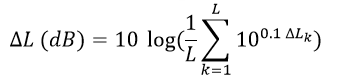
The following conditions must be satisfied:
- The uncertainty of the audibility ∆L shall not exceed +/-1.4 dB. This is generally the case with evaluation of at least 12 time-staggered narrowband averaged spectra (in this case, uncertainty calculation is not necessary). If less than 12 averaged spectra are used, then the uncertainty shall be taken into consideration as given in Clause 6 of the standard.
- Where there are alternating operating states, all of the operating states shall be covered by the averaged spectra used.
To fulfill the requirements on the input described in this standard, a series of averaged spectra are computed from the original signal given by the user. Every spectrum is calculated from a part of the signal of approximately three seconds. Each of these averaged spectra is calculated using the same Hanning Window and the same FFT of length N, where N is the number of samples required to reach a spectral line spacing between 1.9Hz to 4 Hz (closest power of two reaching this assumption).
Sound: Analysis and Specification also makes it possible to change the default three second computation steps and the % overlap rate to the desired values. However, the computation step must be greater than three seconds to meet the standard.