


Short fiber reinforced thermoplastics are known to show degraded material properties (stiffness and strength) in the weld line regions. In the literature, several factors have been identified as responsible for this performance degradation (see for example Baradi et al. (2019), Fellahi et al. (1995), Nadkarni et al. (1993) and their cited references):
The fiber orientation in the weld region
The lack of molecular diffusion and healing at the weld line interface
The molecular orientation in the weld region
The formation of voids and V-notches
These factors (and possibly others) play a different role depending on the polymer under consideration, the geometry of the part, and the processing conditions.
Regarding the last three factors listed above, their effects are difficult to model and quantify, but Mechanical captures the effect of the change in fiber orientations in the weld regions when modeling Short Fiber Composites. To show how the Ansys short fiber workflow automatically accounts for this effect, compare the tensile response of a specimen with and without a weld line.
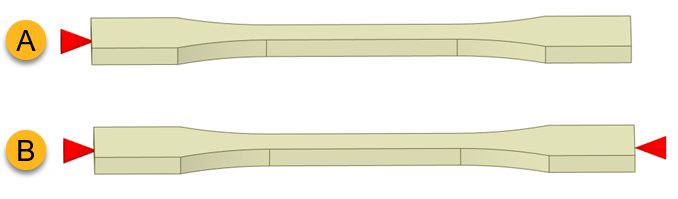
The simplified example shown below considers a specimen made of PBT resin filled with 30% in weight of glass fibers. Two injection molding configurations are simulated: A) a single-gated configuration, no weld lines (A, below) and a double-gated configuration where the melt is simultaneously injected on both sides of the specimen, leading to the formation of a weld line in the middle (B). The red cones indicate the position of the gates where the polymer melt is injected.
The fiber orientations predicted by the injection molding simulation are then imported and mapped in Mechanical.
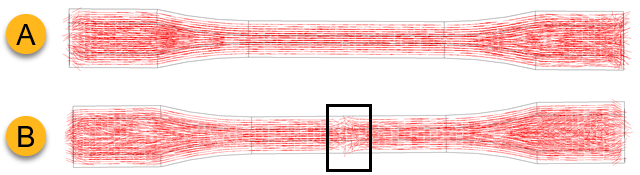
The plots below show the first principal fiber direction in the single (A, below) and double gated (B) configurations. In the latter case, the change in fiber orientation in the middle of the specimen reveals the presence of a frontal weld line.
The Mechanical model is then set up to simulate a quasi-static tensile test as described in the Calibration and Validation of the Elasto-Plastic Properties of a Short Fiber Composite Tutorial. The resulting stress-strain curves obtained until failure as predicted by the Tsai-Hill criterion[1] are shown below.
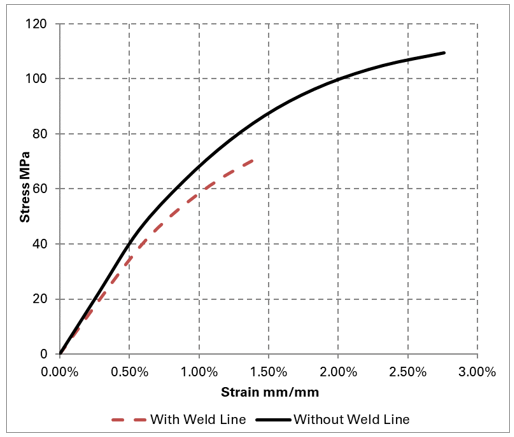
The results of the simulated tensile test demonstrate that just by considering a different fiber orientation distribution, a significant stiffness and strength loss is predicted by the current material model, without requiring a dedicated modeling of the weld line. In cases where this is not sufficient, dedicated material models can be assigned in the weld line regions as shown earlier (see Assigning a Different Material to the Weld Lines).
[1] The Tsai-Hill criterion is discussed further in the chapter Evaluation of Failure Criteria in Ansys Mechanical in the Composites Beta Features documentation. You will find the beta documentation on the Ansys Help website under Composites.