


Aures Tonality
Average Tonality Aures (tu) and Temporal Tonality Aures are based on Aures' model for tonality.
Aures modeled tonality is based on the subjective evaluation of pure tones and bandpass-filtered noises by using 4 weighting functions. These 4 weightings account respectively for the effects of bandwidth, center frequency, prominence of the tone, and loudness of the tone as compared to total loudness. Most of these weightings were proposed by Terhardt et al. (Terhardt E., Stoll G., Seewann M., Algorithm for extraction of pitch and pitch salience from complex tonal signals, J Acous. Soc. Am 71(3),1982).
Temporal Tonality Aures is an output resulting from Average Tonality Aures computation that displays the following three curves in a window:
-
the Aures Tonality vs. Time, in tonality units (tu)
-
the relative loudness weighting WGr vs. Time
-
the tonal component weighting WT vs. Time
The Aures' model details are presented below:
Aures proposed an algorithm for separating the tonal and noise parts in the sound and estimating the tonality through the calculation of the different weightings. The separation procedure is based on a 400-point spectrum for the frequency range between 0 and 5 kHz (corresponding to a line spacing ∆ƒ of 12.5 Hz). A tone is identified when the level of a particular spectral bin is (1) higher than that of the just preceding bin and higher than or equal to that of the just following bin, and (2) at least seven dB higher than those of the two further preceding and the two further following bins. The group of five successive spectral bins centered on that with the maximum level is therefore identified as a tone. Its exact frequency ƒci is calculated with the following formula:

with ƒi the frequency in Hz of the maximum level, Li+1 the level in dB SPL of the upper bin, and Li-1 that of the lower bin.
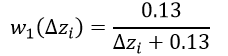
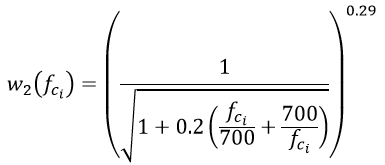
For each ith tone at the frequency ƒci (in Hz) with a level Li (in dB) and a bandwidth Δzi expressed on the Bark scale (namely as a fraction of the critical bandwidth), these functions are defined as follows:
-
The model uses the bandwidth weighting function from Terhardt and others:
-
The frequency weighting function is:
-
The prominence weighting function is:

where ΔLi is the excess level in dB defined by:

and AEk is the secondary excitation at ƒi due to the kth component, EGr is the masking intensity of the noise, and EHS is the intensity at the threshold of hearing.
Aures combines these into the tonal component weighting:
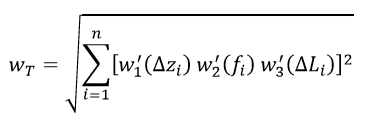
where

The relative loudness weighting accounts for the relative contribution of the tonal loudness to the overall loudness:
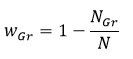
where NGr and N are the loudnesses of respectively the noise and the whole sound (in sones).
Finally, Aures’ Tonality T in tu (tonality unit) is:

where c = 1.09 is a constant chosen such that a one-kHz pure tone with a level of 60 dB SPL would have a tonality of 1 tu.
Sound: Analysis and Specification outputs the following data:
A tonality array over time,
The mean tonality value over time.
Given the rather high line spacing (∆ƒ = 12.5 Hz), the bandwidth weighting w1 is disabled by default (namely w1 = 1 whatever the input). This weighting can be enabled in the parameter window of Aures’ tonality by ticking in the Bandwidth weighting w1 box. In that case, the bandwidth Δzi in Bark rate is defined as the 3 dB bandwidth around the tone frequency (the default 3 dB value can be modified in the Bandwidth threshold field in the parameter window). Then, on each side of the tone frequency (with level Lmax), the limit of this band is computed by linear interpolation between the first two spectral bins with levels closest to Lmax - 3 dB.