


IIHS Headlight Test Environment
This page describes the test environment and the conditions used in the Insurance Institute for Highway Safety (IIHS) test rating in Ansys AVxcelerate Lighting and Sensors.
During an IIHS headlight test, the headlight (light quality of beam) is evaluated to get a better rating according to the standardized IIHS scale.
 : Good
 : Acceptable
 : Marginal
 : Poor.
IIHS Track and Trajectories
The IIHS Track is a realistic track used in Ansys AVxcelerate Lighting and Sensors to test headlights in accordance with the IIHS rating.
The Ansys AVxcelerate Lighting and Sensors IIHS Track is provided in the AVxcelerate IIHS Plugin package. It corresponds to the automatic driving curve and includes five trajectories which appear in the following order: straightaway, right curve (150m radius), left curve (150m radius), right curve (250m radius), and left curve (250m radius).
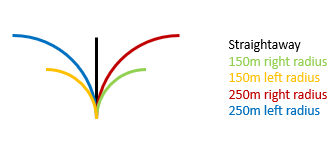
The vehicle is driven non-stop between trajectories and each trajectory is connected by a 100m clothoid curve.
Illuminance and Glare Sensors
The dedicated IIHS track is fitted with photometric sensors which are accurately positioned at specific points (usually the end of each trajectory) as presented below:
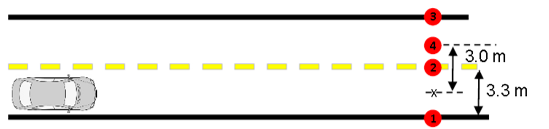
- 1
- Visibility illuminance measurement, 25 cm from the ground
- 2
- Visibility illuminance measurement, 25 cm from the ground
- 3
- Visibility illuminance measurement, 25 cm from the ground
- 4
- Glare illuminance measurement, 110 cm from the ground
- X
- Origin of the measurement coordinate system
Sensors 1 and 3 are positioned at the sides of the road and are used for the Straightaway trajectory.
Sensors 1 and 2 are positioned at the sides of the driving lane and are used for the Curves trajectories.
Sensor 4 is positioned in the middle of the oncoming lane and is used for the glare measurement.
The Ansys AVxcelerate Lighting and Sensors IIHS headlight simulation aims at:
predicting headlight rating in earlier phases of development,
Note: Headlights rating is calculated thanks to a Simulink plug-in.improving lighting systems for higher rating.
The Ansys AVxcelerate Lighting and Sensors IIHS simulation evaluates both low and high beams using the IIHS track, illuminance sensors and the Simulink plug-in.
The vehicle speed, vehicle position and light status are controlled automatically by either Ansys AVxcelerate Lighting and Sensors or the Simulink plug-in. Three sensors measure illuminance values and one sensor measures glare.
The integration type of the illuminance sensor used for IIHS is planar. Please refer to the private version of the documentation for more information.
The illuminance sensors implemented in Ansys AVxcelerate Lighting and Sensors are ideal. The only light source taken into consideration in IIHS is the one coming from the headlamps, the light source defined in the scene.
Simulink Plug-in
During the IIHS test simulation, the Simulink plug-in is connected to Ansys AVxcelerate Lighting and Sensors to exchange variables. The Simulink plug-in allows you to evaluate all the sensors from the IIHS Track.
In each trajectory:
The illuminance sensors located on the IIHS track measure illuminance values.
Illuminance values measured by the sensors and the distance between the car and the sensors are computed and stored in the Simulink plugin.
The IIHS test simulation includes two laps, one for low beam and one for high beam. At the end of the high beam lap, the Simulink model post processes the measured values to calculate demerit values for distance at 5 lux for illuminance and glare.
The overall IIHS rating is calculated from the demerit values and the detailed results of the IIHS test are exported to a PDF file at the end of the simulation.

IIHS Test Simulation Constraints
Ansys AVxcelerate Lighting and Sensors allows you to evaluate headlights through the IIHS test designed in accordance with the IIHS Standards. The test simulation does not consider all conditions present in the real test, however.
Ambient Conditions
- the Environmental extinction coefficient is always 0. Absorption and scattering are not considered.
- Ambient illuminance level is always 0.
Vehicle Under Test
- odometer readings and the vehicle's resulting condition is not considered.
- tire conditions are not considered. Tires are considered perfectly solid.
- weight balance is not considered.
- the light source aging and dependency on the battery are not considered. The Flux value is always defined by the user. If a flux decrease is known, you can modify it in the Ansys AVxcelerate Lighting and Sensors GUI or in the Lighting System Excel file.
- Headlamp aim is defined by the user as the "as received" condition cannot be predicted.
- suspension settings are not considered.
Other Factors
- the illuminance photometer has no tolerance.
- the recommended simulation mode is external synchronization which has a sample time of
0.05 s (20Hz) as opposed to 0.005 s sample time (200Hz). While it is possible to run the
simulation with a 0.005 s sample time, it will take much longer to simulate. The External
Synchronization mode ensures that both Ansys AVxcelerate Lighting and Sensors and Simulink are
running one after the other, allowing for step-by-step closed loop simulations with
deterministic results.Note: To ensure results can be reproduced, you should always run the IIHS Headlight plugin in External Synchronization mode.
- pitching is not considered. In Ansys AVxcelerate Lighting and Sensors the track is completely flat with no elevation, and the number of photometers and their spacing are not defined in the protocol.
- driving precision cannot be predicted. While the real test allows for a certain degree of tolerance and random values can be introduced by 3rd party software to simulate this, in Ansys AVxcelerate Lighting and Sensors the vehicle always follows the specified trajectory for fully deterministic results.
- photometers cannot detect the rays from reflection on the road. A lamp source is represented by a point source and incident light rays hitting the photometer at several different angles will not be represented.