


The Fresnel Number
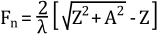
A very useful concept in physical optics modeling is the Fresnel number. Strictly speaking, the definition of the Fresnel number only applies to unaberrated rotationally symmetric beams with a finite extent.
However, the concept is still useful in cases that do not meet these criteria. The Fresnel number depends upon the diameter of the beam, the radius of curvature of the wavefront phase, and the distance to an observation point where the complex amplitude of the field is desired. Conceptually the Fresnel number is the number of annular "Fresnel zones" from the center of the beam to the edge. Fresnel zones are the radial zones where the phase as seen from the observation point changes by π.

A perfectly collimated beam will have a Fresnel number given by

Which for Z greater than A reduces to approximately

Where A is the radial size of the beam and Z is the distance from the beam to the observation point. The Fresnel number becomes small as Z grows large.
For beams that are not collimated, the concept is the same. A converging beam will have a very small Fresnel number if the observation point is near focus. A perfectly spherical beam converging to focus will have a Fresnel number of zero, since there are no zones where the observed phase reaches π. As the observation point moves from the focal region, the Fresnel number increases.
Near and Far Field
If the Fresnel number is small, less than roughly 1, then the beam at the observation point is said to be in the "far field" relative to the current beam. For Fresnel numbers larger than 1, the beam at the observation point is said to be in the "near field" relative to the current beam.
It is important to consider the terms near and far as being relative to the propagation from the present location of the beam to the observation point at which the Fresnel number is computed, rather than having any rigid relationship to the beam position alone. For example, a beam in the exit pupil of an optical system is typically called the near field because the far field is at focus. However, a short propagation from focus to a slightly out of focus observation point is likely a near field propagation if the defocus is small.
The decision as to whether propagation is in the near or far field will determine the choice of diffraction propagation methods.
Next: