


Field Angles and Heights
Field points may be specified as angles, object heights (for systems with finite conjugates), paraxial image heights, or real image heights. Field angles are always in degrees. Positive field angles imply positive slope for the ray in that direction, and thus refer to negative coordinates on distant objects. OpticStudio converts x field angles (αx) and y field angles (αy) to ray direction cosines using the following formulas:



where l, m, and n are the x, y, and z direction cosines.
The signs are chosen so that n > 0 if both αx and αyare less than 90 degrees and n < 0 if αx, αy, or both are greater than 90 degrees. This sign clarification is required because both αx and αyare defined fully in the range of -180 to 180 degrees. For a given set of direction cosines, there can be two different angles which match to the given direction cosines. Following this convention, users should be careful that, if one of the αx and αy is less than 90 degrees and the other is greater than 90 degrees, the projection of the direction cosine onto the XZ and YZ planes may not seems giving the requested angles. For instance, if αx < 90 and αy > 90, the projection of the direction cosines onto the XZ-plane and YZ-plane will look like:
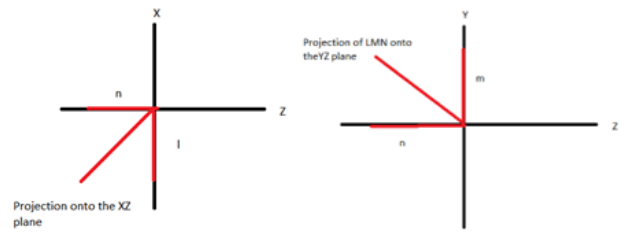
In this case, choosing n < 0 forces us to choose l < 0 to maintain the equation defining l and n and the actual angle in the XZ-plane is αx- 180.
If object or image heights are used to define the field points, the heights are measured in lens units.
When paraxial image heights are used as the field definition, the heights are the paraxial image coordinates of the primary wavelength chief ray on the paraxial image surface, and if the optical system has distortion, then the real chief rays will be at different locations.
When real image heights are used as the field definition, the heights are the real ray coordinates of the primary wavelength chief ray on the image surface.
When angles are used as the field definition, the maximum radial field is used to calculate the normalization of all defined field points. For this reason, the maximum radial field is also called the normalization angle. (See the normalization section in "Field Type" for more information about the difference between the maximum radial field and the maximum field angle.)
OpticStudio uses normalized field coordinates for many features. For information on how field coordinates are normalized, see the "Normalized field coordinates" definition. To set the field type and values, see Fields".