


Extended Polynomial Lens
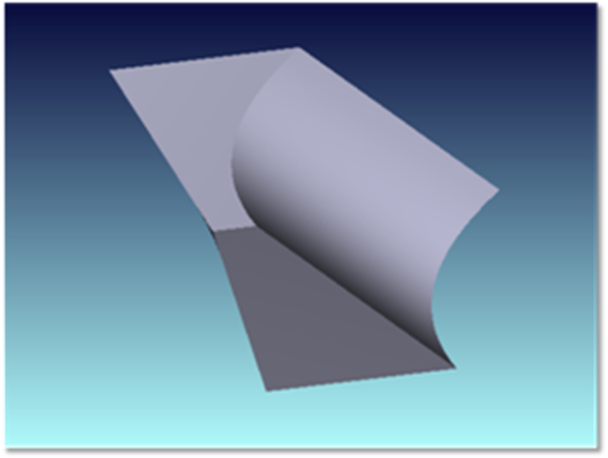
The Extended Polynomial surface shape is defined by:

where N is the number of polynomial coefficients in the series, and Ai is the coefficient on the ith extended polynomial term. The polynomials are a power series in x and y. The first term is x, then y, then x*x, x*y, y*y, etc. There are 2 terms of order 1, 3 terms of order 2, 4 terms of order 3, etc. The maximum order is 20, which makes a maximum of 230 polynomial aspheric coefficients. The position values x and y are divided by a normalization radius so the polynomial coefficients are dimensionless.
The Extended Polynomial sequential surface is converted to the Extended Polynomial Lens object using the Convert to NSC Group tool if the following conditions are met:
- The Extended Polynomial sequential surface must have the Material as MIRROR with a thickness specified.
- The aperture must be circular, elliptical, rectangular, or a user-defined aperture (UDA).
The Extended Polynomial Lens object consists of two of these faces, separated by a thickness. The total object shape is defined by these parameters:
| Parameter # | Description | Face Name | Face # |
| 1 | The radial height of the lens object in lens units. This value is used for the y direction half height if the lens is rectangular. | NA | NA |
| 2 | The x half width of the lens object in lens units. If zero, the lens is circular; otherwise, the lens is rectangular. | NA | NA |
| 3 | The center thickness of the lens in lens units. | Side | 0 |
| 4-5 | Unused. | NA | NA |
| 6 | The front face radius of curvature. If this value is zero, then the curvature is assumed to be zero. | Front | 1 |
| 7 | The front face conic constant k. | Front | 1 |
| 8 | The front face normalization radius. | Front | 1 |
| 9 | The front face number of extended polynomial terms. | Front | 1 |
| 10 | The rear face radius of curvature. If this value is zero, then the curvature is assumed to be zero. | Back | 2 |
| 11 | The back face conic constant k. | Back | 2 |
| 12 | The back face normalization radius. | Back | 2 |
| 13 | The back face number of extended polynomial terms. | Back | 2 |
| 14-247 | The front and back polynomial coeffecients (up to 234 terms total). The coefficients for the back face start after the last coefficient for the front face. | Front & Back | 1 & 2 |
The reference coordinate is the center of the front face. Face Numbers: Front face Face 1, back face Face 2, all other faces Face 0.
Next: