Part cost estimator model parameters
The cost of a manufactured part or component is dependent not only on the material cost, but also on the complete processing chain. Cost is affected by the choice of material, part size, part complexity, batch size, processing methods, recycling of waste material, and so on.
All these contributions, and more, need to be considered when evaluating the cost per unit of engineering function (for example, stiffness, strength) of a component.
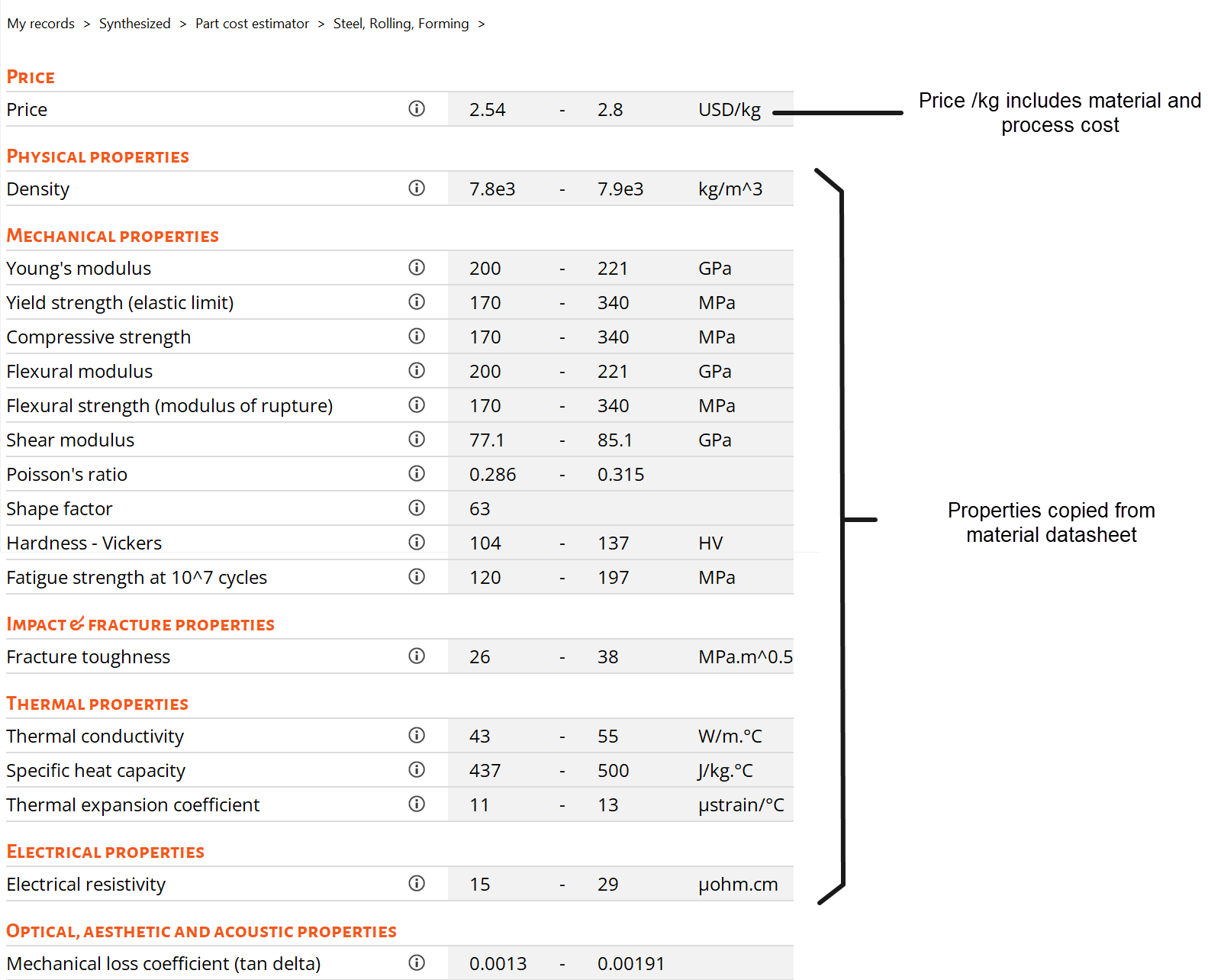
The Part Cost Estimator in Selector draws on information from different sources within Selector (such as material datasheets, ProcessUniverse processes etc.) to evaluate the total cost of a component. The total part cost estimate can be plotted on a chart for easy comparison between different processing methods, or to understand how one particular phase of the production chain affects the overall part cost.
The Part Cost Estimator is suited for use in the early stages of component development, where multiple materials and processing methods are under consideration, and the details of the design have to be finalized. It is particularly effective at comparing materials of different classes, for example replacing a metal component with an injection molded plastic or composite.
The emphasis of the cost model is to compare different processes by predicting the relative cost of each process (to ±20%), rather than achieving high precision (±3%) for each individual process.
| Section | Parameter | Description |
|---|---|---|
| Component details | Material | Set the material record. |
| Value of scrap material | Value of selling waste material back to the supplier, expressed as a percentage of initial material cost. This value is used to calculate the credit from recycling (Crp) if the scrap material is recycled. | |
| Part mass | Mass of the final component. | |
| Part length | Maximum length of part. For continuous shaping processes, this is the length of sheet or profile used. | |
| Batch size | You can enter a single value, list, or range. | |
| Number of values | When a range is specified, the number of records to generate within the range. | |
| Primary shaping process | Primary Process | A suitable primary shaping process. Only processes with data to support the Part Cost Estimator are shown. You must decide which shaping processes are applicable for the material choice. |
| Availability | If using semi-finished feedstock, select 'Off-the-shelf form'. | |
| Part complexity | High level indication on how complex a component shape is:
|
|
| Load factor | Fraction of time in a day for which the manufacturing equipment is running. | |
| overhead rate | Cost of running the facility in a given country, based on local labor rates and energy costs. | |
| Capital write-off time | Length of time until cost of non-dedicated capital equipment is written off. | |
| Secondary shaping process | Include secondary process | Select to add a machining process or another shaping process to the production line. |
| Secondary Process | The process record. | |
| Part complexity | High level indication on how complex a component shape is:
|
|
| Amount of scrap | Percentage of the material that is lost in the process. | |
| Scrap recycled? | Whether the scrap is recycled. | |
| Record Naming | Material | The abbreviated name. For example, if your source record is Aluminum, type Al. This is used to create the record names for the new materials. |
| Primary Process | The abbreviated name. For example, if your source record is Aluminum, type Al. This is used to create the record names for the new materials. | |
| Secondary Process | The abbreviated name. For example, if your source record is Aluminum, type Al. This is used to create the record names for the new materials. |