


Editing Equations and Logic data
Equations and Logic Attributes store numerical data as an expression that describes how the value varies dependent on one or more parameters.
You may also see this type of Attribute also referred to as "math functional" or "EEL".
The calculation of expressions is performed in database units. The result will then be converted to the relevant display unit, if it is different.
Values are stored to a maximum of 15 significant figures.
Example: the data on applied stress vs. number of cycles to failure in this steel record is provided by the Equations and Logic Attribute Fatigue strength model (stress range):
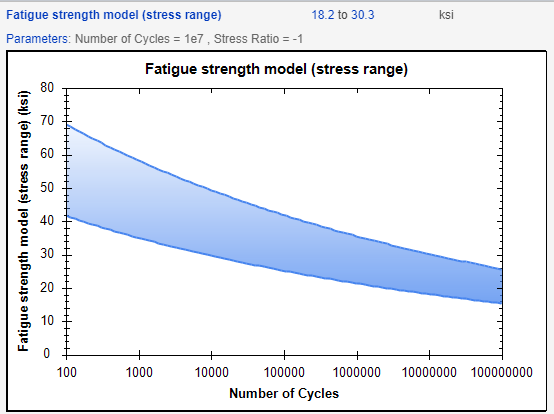
Values here are calculated using the following Fatigue Model Expression:
[A:Tensile strength] / ((1 + [P:Stress Ratio]) / (1 - [P:Stress Ratio]) + [A:Tensile strength] / (([A:Tensile strength] * (1 + [A:Elongation] / 100) - [A:Yield strength (elastic limit)]) / (log(1 + mean([A:Elongation] / 100)) - [A:Yield strength (elastic limit)] / (1000 * [A:Young's modulus])) * log(1 + mean([A:Elongation] / 100)) * (2 * [P:Number of Cycles]) ^ -0.6 + [A:Tensile strength] * (1 + [A:Elongation] / 100) * (2 * [P:Number of Cycles]) ^ (log10(mean([A:Fatigue strength at 10^7 cycles] / ([A:Tensile strength] * (1 + [A:Elongation] / 100)))) / log10(20000000))))