


Working with simple numeric data
Simple numeric data may be stored in Integer, Point, or Range Attributes.
Integer data
Integer Attributes are used to store numbers that are whole, or without a decimal point. For example:

Point data
Point Attributes are used to store exact numeric data with decimal points. For example:
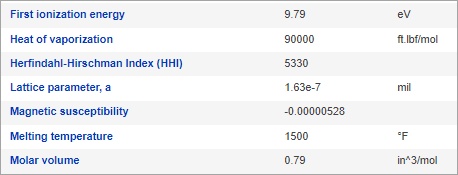
Point values may be entered as an integer or decimal, or formatted with an exponent, and values are stored to a maximum of 15 significant figures. Values must be within the range: 1.5e-45 to 3.4e38 1e-039 to 1e+038 for positive values.
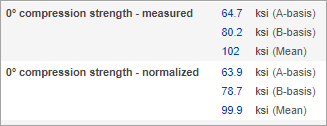
Multi-value Point Attributes can have a range of data values based on one or more parameters. For example, the value for these two Point Attributes depends on the value of the Basis parameter (Mean, A-basis, or B-basis):
Range data
Store a pair of numeric values representing the upper and lower bounds of a value range. For example:
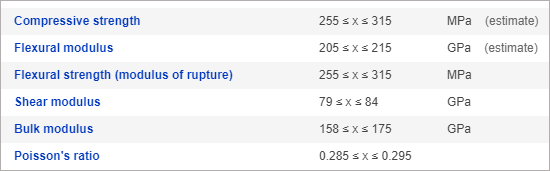
Values may be entered as an integer or decimal, or formatted with an exponent. Values are stored to a maximum of 15 significant figures, and must be within the range:
- ±1.5×10-45 to ±3.4×1038
- 1e-039 to 1e+038 for positive values
Range Attributes can be closed, meaning both maximum and minimum values are specific, or open, meaning that only the maximum, or only the minimum value is defined:

The upper and lower range boundaries may be inclusive or exclusive:
- An inclusive bound means that the boundary point itself is included in the range.
- An exclusive bound means that the boundary point is not included in the range.
Example 1: in this bounded range example:

- The lower bound is exclusive: the value must be greater than 7550.
- The upper bound is inclusive: the value must be equal to or less than 7650.
Example 2: in this open range example:

- The lower bound is not specified, making this an open range.
- The upper bound is inclusive: the value must be equal to or less than 7650.