
Terminal-Based Models for Circuit Analysis
It is possible to use the transformations developed above to compute terminal-based admittance (Y), impedance (Z) and pseudo-S-matrices (Sp). First consider the admittance case. A relationship of the form i =Yv is needed that gives the vector of terminal currents i = [ik] as a function of the vector of terminal voltages v = [vk]. It is known that
|
|

|
(1) |
and
|
|

|
(2) |
It is also known that the incident and scattered modal amplitudes are related by b = Sa, where S is the modal S-matrix computed by HFSS. Therefore:
|
|

|
(3) |
|
|

|
(4) |
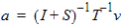
Here I denotes an identity matrix of the same size as S. i can then be solved for in terms of v by eliminating the incident wave variable a.
|
|
|
(5) |
|
|

|
(6) |
The terminal-based admittance matrix Y is identified from the above expression as:
|
|

|
(7) |
A similar relationship can be developed for the terminal-based impedance matrix:
|
|

|
(8) |
It is also possible to convert the terminal-based admittance and impedance matrices into a terminal-based "pseudo-S-matrix" Sp. To do this, a reference impedance matrix must be specified. Then standard formulas are used to convert the terminal impedance matrix Z into the terminal S-matrix
|
|

|
(9) |
Zref can be either a user defined diagonal reference impedance matrix or the terminal characteristic impedance matrix, Zo, which is the matched case for terminal-based models.
The terminal S-matrix Sp relates the intensities of the incident and reflected pseudo-waves at the terminals.
|
|

|
(10) |
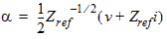
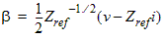
These pseudo-waves are defined by:
|
|
|
(11) |
|
|
|
(12) |
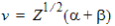
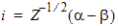
Note that the units of a and b are watts1/2. The terminal voltages and currents can also be written in terms of the pseudo-waves.
|
|
|
(13) |
|
|
|
(14) |
Unlike true waveguide modes, the pseudo-waves a and b have no associated propagation constant. The pseudo-waves represent linear combinations of several modes, which may all have differing propagation constants. HFSS is still capable of performing deembedding on the terminal-based S-matrix, but this is accomplished by first deembedding the modal S-matrix and then performing the transformation back to a terminal-based S-matrix.
For the normalization of terminal voltages in the Fields Post Processor, see Scaling a Source's Magnitude and Phase.