
3D Modeler Discovery Link
The 3D Modeler Discovery Link allows you to create a User-Defined Model (UDM) from the geometry model in an Ansys Discovery project. Discovery Link can be used only if Discovery with the same version as Ansys Electronics Desktop is installed on the same machine. Discovery Link is only available on Windows.
Discovery Link provides following functionality:
- Browse and select Discovery project files (*.dsco) to import geometry directly.
- Import geometry by connecting to an active Discovery session.
- The Discovery geometry is imported as a UDM along with geometry parameters with units, rendering attributes and material assignments. Object, material, and parameter names with non-ASCII characters are not supported.
- The Discovery geometries can be imported as faceted bodies if the design supports lightweight geometries.
- A Discovery document referenced by a Discovery link is included in the project archive automatically.
- You can break a Discovery link. In this case, all the parts in the UDM are converted to imported objects.
Importing Discovery Geometry into Ansys Electronics Desktop
To select a Discovery file:
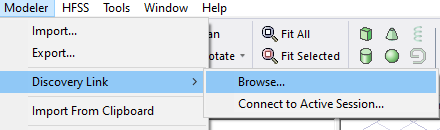
- Select Modeler > Discovery Link > Browse or Browse Discovery in the Model ribbon.
- Navigate to and select a *.dsco project to load into the Modeler window.
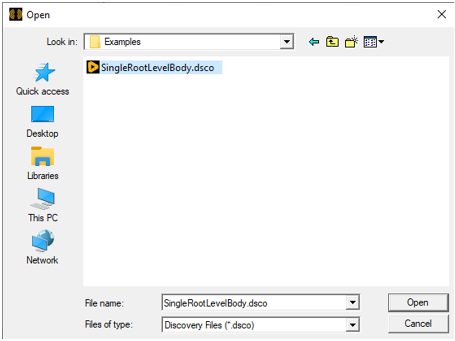
- Click Open.
The progress bar displays import progress. When the model has loaded, it appears in the Modeler window, and in the history tree as a User-Defined Model (UDM) listed under Discovery.
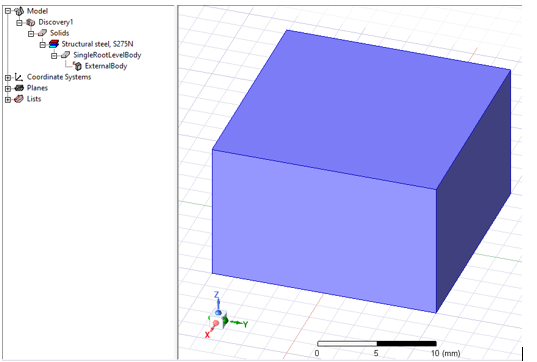
If there is an active Discovery session which is using the selected document, the created UDM will be linked to the active Discovery session. If there is not one, a new non-graphical Discovery session will be used, which makes the creating and refreshing slow. Afterwards, if an active Discovery session is launched and opens the document, the UDM will be linked to the active session.
Note that if the Import Named Selections option is checked in the Tools > Options > General Options > 3D Modeler > Discovery Link window, named selections created in Discovery will be listed in the Named Selections branch of the history tree:
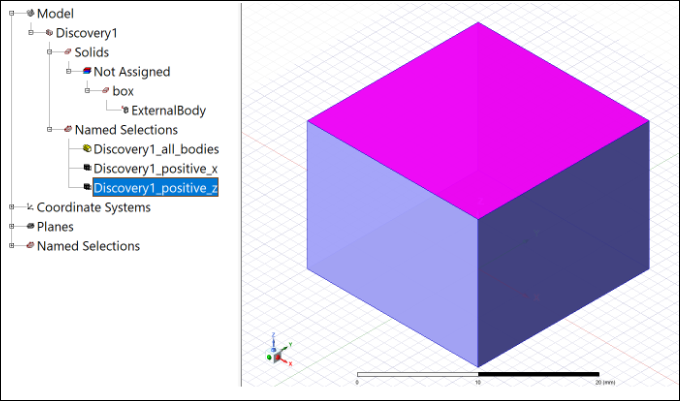
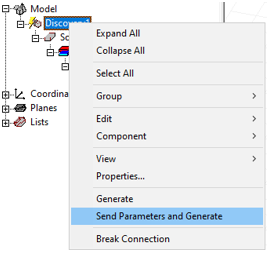
To synchronize imported named selections with Discovery, right-click on the UDM (Discovery1 in the preceding example), and select Generate or Send Parameters and Generate. Within Ansys Electronic Desktop, the imported named selections cannot be directly modified or deleted without deleting the whole UDM.
Preserving IDs During Parametric Variations
When a model is imported, IDs in Ansys Electronic Desktop depend on IDs available from Discovery or other source CAD software. If parameters in Discovery are set up such that changing their values causes existing parts to be edited, then IDs in Discovery and Ansys Electronic Desktop remain constant across parametric variations.
However, if IDs in the source CAD or Discovery change during a parametric update, then Ansys Electronic Desktop cannot match object/faces across variations. Ansys Electronic Desktop might delete original objects and create new objects, causing deletion of boundary conditions and failures in parametric simulations. Such a situation can commonly occur when an embedded script is used in Discovery, and the script clears all parts at the beginning of script.
Named selections can be used in such situations to preserve IDs of objects/faces so that parametric simulations can proceed. In such cases, use the following guidelines:
- The total number of objects must be kept the same across parametric variations.
- If part IDs are changing in Discovery, users must include every part in at least one object named selection and keep the name of each part constant across parametric variations.
- Discovery can have multiple parts with a same name. Ansys recommends assigning a unique name to every part and creating an object named selection that includes all parts in the model. If duplicate names cannot be avoided, then multiple named selections can be created so that parts with the same name are in different named selections. Ansys Electronic Desktop will match objects in a named selection by using their names and preserve IDs across parametric variations. This will preserve boundary conditions or other assignments in Ansys Electronic Desktop.
- If a named selection has a single face, then the ID of that face in Ansys Electronic Desktop will be kept constant across parametric variations even if it changes on Discovery side. If a named selection has multiple faces and the IDs of these faces change in Discovery, then Ansys Electronic Desktop cannot guarantee that the ID of each face in that named selection will be preserved consistently. It is possible that IDs may switch among faces in that named selection. Ansys recommends creating a separate named selection for each face on which boundary/excitation is added in Ansys Electronic Desktop.
- If the number of faces in a named selection changes across parametric variations, then the face IDs may not remain constant.
Connecting to an Active Discovery Session
If one or more Discovery sessions are running on the machine, Discovery link can connect to them to import geometry.
When you select Modeler > Discovery Link > Connect to Active Session or Connect to Discovery in the Model ribbon, the Active Discovery Sessions dialog box appears.
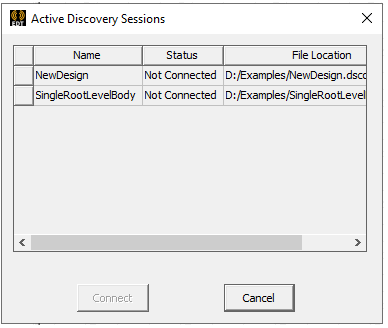
It shows all active Discovery sessions with their document names and connection status. Sessions which are not using a saved document are not included. You can select a session and click Connect to import geometry from that session. Once connected, that session will be used to regenerate the corresponding Discovery link UDM.
Property Window of Discovery Link UDM
The Property window of a Discovery link UDM has three tabs:
- The General tab shows general information such as Discovery document path.
Note that the Geometry File Path is editable; users can update the path if the original file is moved.
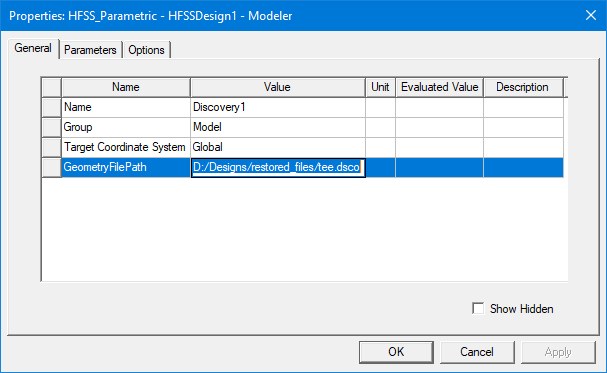
- The Parameters tab shows all parameters.
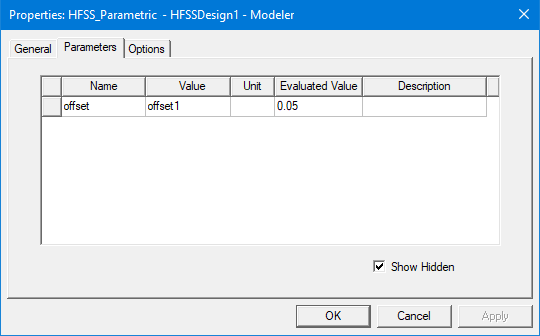
- The Options tab shows supported options. Note that Materials\Assignments and Properties is only available for Icepak and Mechanical designs. See Discovery Link Options for details on the options in this window.
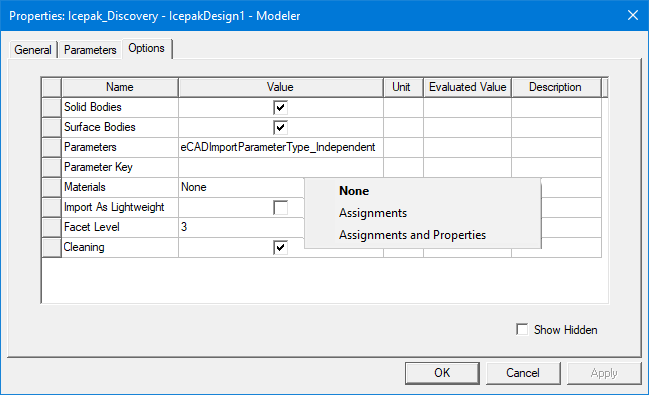
You can edit the parameters and send them back to Discovery to get the geometry updated accordingly.
After editing the parameter, you will need to use Send Parameters and Generate in the context menu of the Discovery link UDM. If there is an active Discovery session linked, its model will be updated but not saved. If there is not an active Discovery session linked, the Discovery document will not be updated.
Archive a Project Containing Discovery Link
If you want to share a project with Discovery link with other users, you need to archive the project, because the linked Discovery file is not included in the project file. When archiving, the Discovery documents corresponding to the links will be included in the project archive automatically. Once the archive file is unarchived, referenced Discovery documents will be put in restored_files subfolder in the project directory. All definition paths are updated to refer to the reference files in restored_files folder.
Break Connection with Discovery Link
A Break Connection command is available in the context menu of the Discovery link UDM.
- Break Connection converts the UDM bodies to imported objects. The UDM will be removed.
- Any operations that you have performed on UDM bodies are preserved.
- Parameters of the UDM are lost. You lose the ability to create parametric variations with Discovery parameters.
- Attributes such as rendering attributes, materials, etc., are preserved.