
Radiated Power
Radiated power is the amount of time-averaged power (in watts) exiting a radiating antenna structure through a radiation boundary.
For a general radiating structure in HFSS, radiated power is computed as
|
|
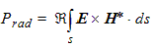
|
(1) |
where
- Prad is the radiated power in watts.
- Âis the real part of a complex number.
- s represents the radiation boundary surfaces.
- E is the electric field.
- H* is the conjugate of the magnetic field.
- ds is the local radiation-boundary unit normal directed
out of the 3D model.
Note:
The accuracy of the computed radiated power depends on the accuracy of E and H. In some cases it is possible that the computed radiated power may deviate slightly from the actual radiated power.
The accuracy of the computed radiated power depends on the accuracy of E and H on the absorbing boundary. In some cases it is possible that the computed radiated power may deviate slightly from the actual radiated power. To increase the accuracy of the radiated power, seed the mesh on the absorbing boundary.
As a default behavior for SBR+ design and SBR+ hybrid design, an additional SBR+ power loss is subtracted from the total radiated power. For each source i, the SBR+ power loss Liover all other sources j is computed as

where
-
ℜ is the real part of a complex number
-
Sji is the S parameter from SBR+. When source i and j come from the same component instance, Sji includes only scatter component. Otherwise,Sji includes both scatter and incident components.
-
ai is the scaling factors specified in Edit Source.
-
 is the conjugate of bj.
 -
Pi is port characteristic matrix