
Maximum Near-Field Data
The parameters listed in the Max Field Data window remain the same regardless of the geometry over which they were calculated. However, the coordinates displayed change depending on the geometry.
On a sphere, the coordinates — phi and theta — of the maximum value are listed under Phi and Theta. The values are given in volts per meter. Along a line, the coordinates — x, y, and z — of the maximum values are listed under X, Y, and Z. The values are given in volts per meter, and the coordinates are given in meters.
The following parameters are listed:
|
Total |
The maximum of the total E-field. |
|
X |
The maximum E-field in the x-direction. |
|
Y |
The maximum E-field in the y-direction. |
|
Z |
The maximum E-field in the z-direction. |
|
Phi |
The maximum E-field in the f-direction. |
|
Theta |
The maximum E-field in the q-direction. |
|
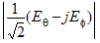
LHCP |
The maximum left-hand circularly
polarized component, which is equal to |
|
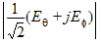
RHCP |
The maximum right-hand circularly
polarized component, which is equal to |
|
Ludwig 3/X dominant |
The maximum of the dominant component, Vmain, for an x-polarized aperture using Ludwig's third definition of cross polarization. This is equal to |Eqcosf - Efsinf|. |
|
Ludwig 3/Y dominant |
The maximum of the dominant component, Vmain, for a y-polarized aperture using Ludwig's third definition of cross polarization. This is equal to |Eqsinf + Efcosf|. |
 .
. .
.