
Tubular Band Pass Filters
The passive circuit schematics will have a check box in the tool bar for "Tubular". Check this box, and a tubular band pass filter will be displayed. The first element of the filter will match the series/shunt selection in the Passive Control Panel. If the selected pass band is too wide, you will receive an error message informing you that you need to reduce the width of the pass band.
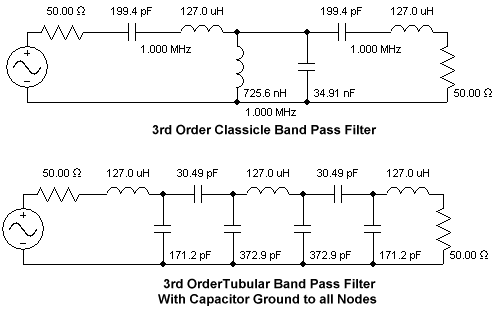
Tubular band pass filters are narrow band approximations of band pass filters. The advantages to using tubular over classical band pass filters are: more desirable element values at high frequencies, flexible element value selections, and all nodes are attached to a grounded capacitor. Any parasitic node capacitance that results in the physical construction of the filter may be subtracted from the design value of the grounded capacitor connected to that node. In most cases, the inductance values adjustable.
Tubular filters consist of an alternating series of inductors and capacitors, with each node containing a grounded capacitor. FilterSolutions permits tubular with or without a leading shunt capacitor, with an inductor or a capacitor first series element being, a "Minimum Elements" selection that minimizes the number of elements by skipping series capacitors, and an outer shunt inductors option to place the outer inductors shunt rather than series.
The "Minimum Elements" selection requires fewer parts, but has the disadvantage of requiring a wider range of required capacitor values.
The outer shunt inductors option has the advantage of minimizing the outer frequency errors at the expense of increasing narrow band approximation errors near the center frequency.
When the tubular filter is displayed, the Tubular control panel is displayed in the upper right of the circuits window. You are offered the choice of leading inductor, leading capacitor, minimum parts, and outer shunt inductors; and you may recalculate with new tubular element values. To calculate the tubular filter with new parts, Enter the desired inductance, and select "Recalc" to update the filter. Tubular filters without leading shunt capacitors require third order or higher to redesign with different elements.
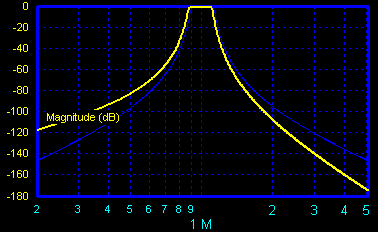
The magnitude frequency response error is shown below. Grey baseline traces depict the true Chebyshev response. Blue depicts the tubular filter response. Note that the error is only significant at frequencies of very high attenuation.
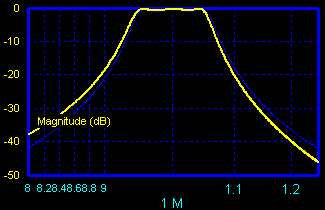
Tubular Frequency Error
Outer Shunt Inductors
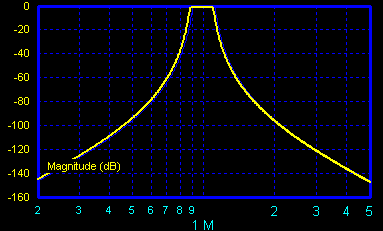
Tubular (and resonator) filters introduce an asymmetric frequency response error into band pass filters. The asymmetrical error may at times be undesirable. This asymmetrical frequency error may be minimized by using the outer shunt inductor option. See examples of fourth order Chebyshev filters below.
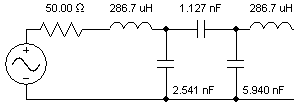
Standard Leading Series Inductor Tubular Design
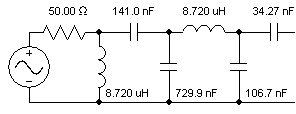
Leading Shunt Inductor Tubular Design
With Reduced Asymmetrical Frequency Error
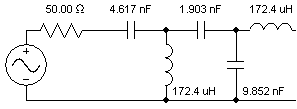
Leading Series Capacitor and Shunt Inductor Tubular Design
With Further Reduced Asymmetrical Frequency Error
Note that the leading series capacitor shunt inductor design is the most effective in reducing asymmetrical frequency error. However, this design produces the greatest narrow band approximation error in the passband, and the default design does not have a shunt capacitor attached to the first node. A simple Norton transformation can place a shunt capacitor at the first node if desired.
Low Pass Approximation Tubulars
This function is supported for Chebyshev I filters only. A low pass filter with a narrowly constricted passband behaves like a tubular filter in the frequency ranges about the pass band. The advantage is that a filter with fewer parts is required, and DC coupling is provided for applications that require band pass filters with DC coupling. The disadvantage is that the element sizes may differ dramatically within the filter, and many applications do not permit DC coupling.
Low pass approximation tubular filters may be useful when DC coupling and dramatically differing element values are not an issue. Such a filter may be designed manually by setting the cutoff frequency and percentage pass band constriction. The inclusion of this function into the Tubular menu is simply a matter of convenience.
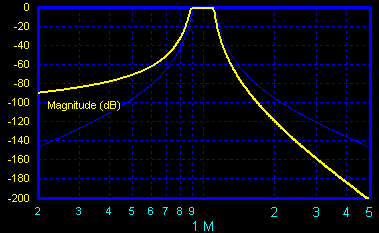
Below is an example of the low pass approximation tubular features. It is easily seen that the passband is essentially the same in both the true tubular and the low pass approximation; that the low pass approximation has far fewer elements, and that DC coupling and large part value spread exists in the low pass approximation tubular.
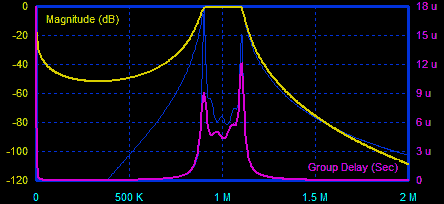
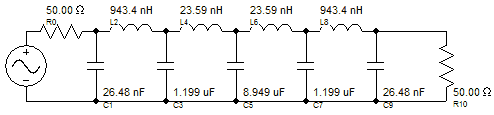
5th Order Low Pass Approximation Tubular
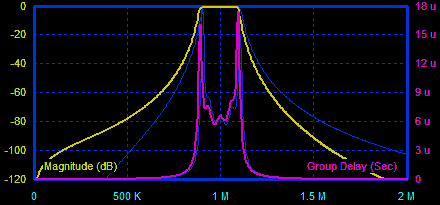

5th Order Actual Tubular