
Lumped Coupled Resonator Simulations
Lumped Equivalent Coupled Resonator Filter may be produced by selecting a band pass filter with Lumped Translation or Inductor Translation selected, then checking the Resonator translation check box at the top of the distributed schematic. Inductor Translation will leave capacitors alone and only translate the inductors and stub resonators to a distributed topology.
If it is desired to simulate LC resonators with a single stub, select Combine Stubs option on the main control panel. The resulting transmission line coupling stubs then behaves like ideal capacitors or inductors. The Use Coupled Lines option in conjunction with Combine Stubs uses coupled lines to simulate LC resonators.
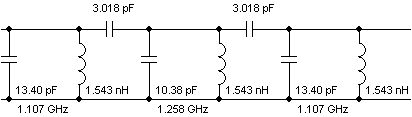
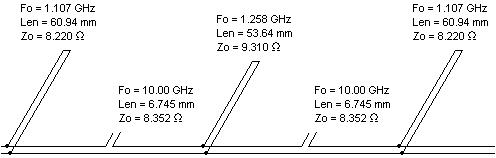
Coupled Resonator Filter With Lumped Capacitor Couplers
The short coupling stubs in the 1 GHz transmission line filter above simulate ideal capacitors that alias at 1000 GHz. For all practical purposes, they may be assumed to be ideal capacitors in the simulation. The single stub resonators in this example will produce significant aliasing, as shown below. The background blue trace is the classical band bass transmission line simulation.
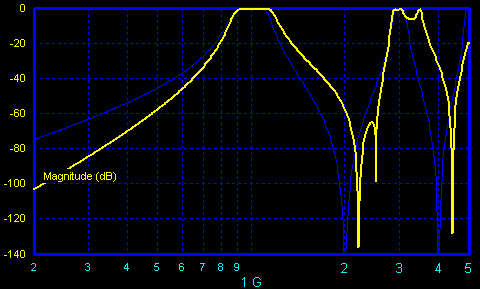
Coupled Resonator Aliasing
Alternatively, transmission lines may be replaced with lumped elements. See the section on line/lumped composite filters.
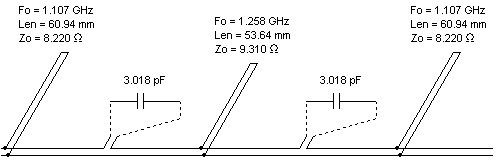
Composite Transmission Line/Lumped Coupled Resonator Band Pass Filter
Using a top series coupling inductor model (or shunt coupling inductor model for series coupled resonator) instead of a capacitor permits the use of a microstrip or stripline segment inductor simulation. Combining the shunt stubs (or series stubs in the case of series coupled resonators) into a resonator reduces the physical size of the filters.