
Raised Cosine Filters
The Raised Cosine Filter is for use in communications. The distinguishing characteristic of a Raised Cosine Filter is the symmetry of the magnitude frequency response on either side of the pass band cutoff frequency and a constant group delay throughout the pass band and into the stop band until 15 to 20 dB of attenuation is achieved. The magnitude frequency response of the filter is ideally a raised cosine function. The accuracy of the raised cosine function increases as the order of the filter increases. FIR Raised Cosine filters are more accurate than analog or IIR Raised Cosine filters.
FilterSolutions analog and IIR Raised Cosine filters are produced by minimizing the square of the error between the ideal filter and the actual and then delay equalizing out to 20 dB of attenuation
In FilterSolutions, the definition of the order of an analog or IIR Raised Cosine filter does not include the delay equalization part of the filter.
The ideal raised cosine filter frequency response consists of unity gain at low frequencies, a raised cosine function in the middle, and total attenuation at thigh frequencies. The width of the middle frequencies are defined by the roll off factor constant Alpha, (0<Alpha<1). In FilterSolutions, the pass band frequency is defined as the 50% signal attenuation point.
The selection of Alpha is based on the filter requirements. Real filters with low Alphas produce more ISI due to filtering error, but use less bandwidth. Real filters with high Alphas produce less ISI, but use more bandwidth.
When the pass band frequency of a raised cosine filter is set to half the data rate, then the impulse response Nyquist's first criteria is satisfied in that the impulse response is zero for T = NTs, where N is an integer, and T is the data period.
Mathematically, the frequency response may be written as:
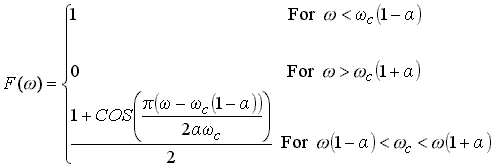
Raised Cosine Filter Frequency Response
The ideal raised cosine filter frequency response is shown below:
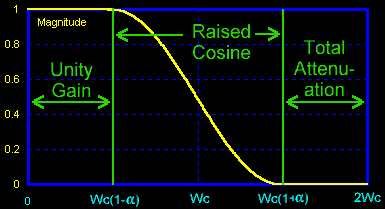
Ideal Raised Cosine Frequency Response
The FIR Raised Cosine filter is synthesized by encoding its impulse response directly into the Z transform numerator:
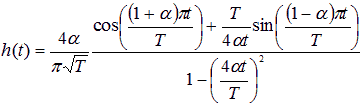
Raised Cosine Impulse Response
Root Raised Cosine Filter
The ideal root raised cosine filter frequency response consists of unity gain at low frequencies, the square root of raised cosine function in the middle, and total attenuation at the high frequencies. The width of the middle frequencies are defined by the roll off factor constant Alpha, (0<Alpha<1). In FilterSolutions, the pass band frequency is defined as the .707 half power point.
The root raised cosine filter is generally used in dual series pairs, so that the total filtering effect is that of a raised cosine filter. The root raised cosine filter is generally used in series pairs, so that the total filtering effect is that of a raised cosine filter. The advantage is that if the transmit side filter is stimulated by an impulse, then the receive side filter is forced to filter an input pulse shape that is identical to its own impulse response, thereby setting up a matched filter and maximizing signal to noise ratio while at the same time minimizing ISI.
Mathematically, the frequency response may be written as:
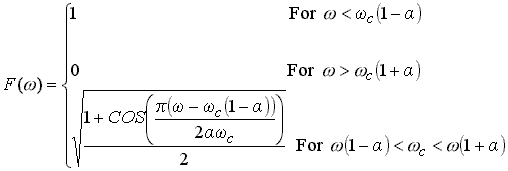
Root Raised Cosine Filter Frequency Response
The ideal root raised cosine filter frequency response is shown below:
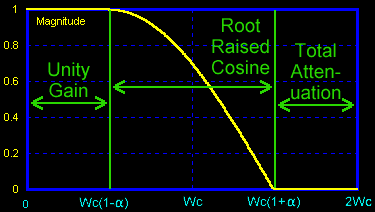
Ideal Root Raised Cosine Frequency Response
The FIR Raised Cosine filter is synthesized by encoding its impulse response directly into the Z transform numerator:
Ideal Root Raised Cosine Impulse Response
Data Transmission Filters
Data Transmission Filters are filters designed to minimize ISI without the need for a constant group delay. These filters are more efficient than analog raised cosine filters in that they do not require delay equalization components. However, only postcursor ISI is eliminated, that is ISI that occurs after the peak of the impulse response. Data Transmission Filters are created in FilterSolutions by minimizing the sum of the squared ISI error with numerical methods. This derivation is not unique. Other solutions for Data Transmission Filters are known to exist, such as that found in The CRC Handbook of Electrical Filters. The solutions offered by FilterSolutions has the advantage of offering the user flexibility in designing for accuracy vs. bandwidth by selecting different Alpha values.
An inspection of the data transmission filter impulse response shows that precursor ISI may be generally eliminated by doubling the pass band frequency. However, this has the undesirable effect of doubling the required bandwidth of the data channel or lessening the filtering quality.
Like Raised Cosine filters, the presence of element value errors increases ISI more in the low alpha filters than the high alpha filters, and high alpha filters require more bandwidth than low alpha filters.