
Radial and Delta Stubs
Open stub capacitor approximation geometry can sometimes be improved with the use of radial and delta open end stubs in place of straight open end stubs. Radial and delta stubs are generally shorter than straight stubs, and sometimes have improved performance in higher order modes. FilterSolutions radial and delta stubs normally attach at a base width of H/2 , where H is the total dielectric height, and protrude out at a specified angle. Excessively fat stubs widen the base width beyond H/2, however. For shunt capacitor approximations, the synthesis algorithms attempt to maintain the impedance at the cutoff frequency and stop band null frequency. The constant angle selection only maintains the cut off frequency impedance, and lets the stop band null frequency meander from stub to stub. LC resonant capacitors maintain impedance at the LC resonant frequency.
The impedance computations for micro strip radial stubs and all delta stubs use standard text book equations, with a few customized improvements to aid in accuracy. Strip line radial stubs are a product of internal Nuhertz research.
The angle range of a radial stubs is 15 deg to 140 deg. For delta stubs it is 15 deg to 120 deg. Fixed angle stubs may use angles less than 15 deg, but not greater than the upper angle limit.
Radial Stub Geometry
Radial stubs are defined by the angle, width, inner radius, and outer radius, as shown in Figure 1 below. Since only three dimensions are needed, one of the four must be computed as a function of the other three.
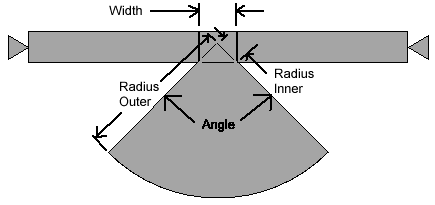
Figure 1: Radial Stub Geometry
Delta Stub Geometry
Delta stubs are defined by the angle, width, and length, as shown in Figure 2 below.
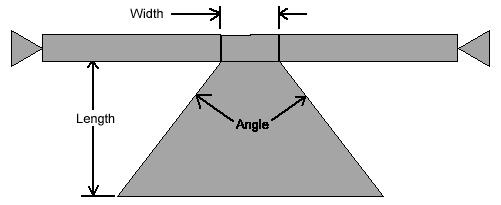
Figure 2: Delta Stub Geometry