
Matching Unequally Terminated Filters
Filters designed with unequal terminations tend to have undesirable reflections (S11 and S22) that may not meet design specifications, as may be seen below in a classic unequally terminated 150 Ohm source and 50 Ohm load Elliptic band pass filter. Note the poor S11 performance, as shown below in the termination mismatched 5th order classical Elliptic design.

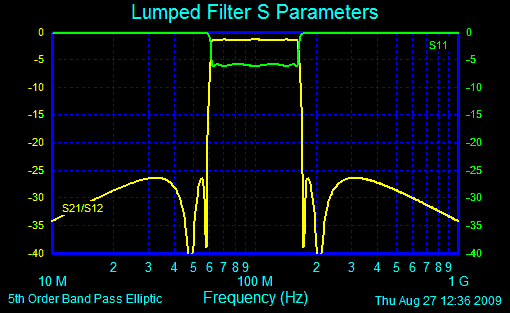
Impedance Mismatched filter and S12/S11
If the case of band pass filters, this potential problem is almost always correctable with the application of one or more Norton transformations to a comparably designed filter designed with equal terminations.
Norton transformations may be applied manually with the use of the right mouse key on any PI, TEE, or L set of like elements, PI arranged parallel LC resonators, and Tee arranged series LC resonators. Applying manual Norton transformations sometimes requires the rearranging of parts with the use of the right mouse key to get them into the needed PI, Tee, or L formation before a Norton may be applied.
Automatic Matching of Unequal Terminated Band Pass Filters
Checking the "Match Impedance" check box in the lumped control panel on the right side of the Main control panel has the effect of designing an equally terminated filter and applying the necessary Norton transformation to create the specified termination resistors. This is sometimes a significant time saver when multiple Norton transformations are needed and/or when element s require significant rearranging to get them into the required Norton configuration.
Below is the same classical band pass filter that has been automatically matched by internal rearrangement of parts and strategic application of Norton transforms. Note the source is still 150 Ohms, and the load is still 50 Ohms.

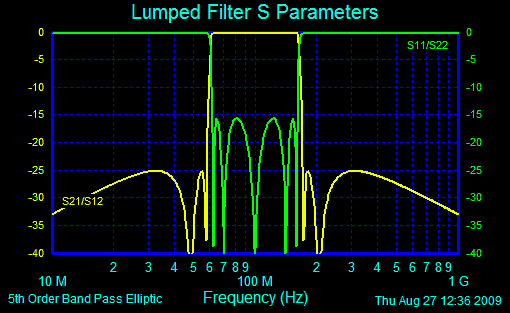
Impedance Matched filter and S12/S11
Note the greatly improved S11 performance through automatic impedance matching of mismatched terminations.
Matching Minimum Zigzag Filters
It should be noted that the above filter is more efficiently designed with a Zigzag topology as shown below, which would require only four inductors for both the matched and unmatched versions, instead of the seven unmatched and eight matched inductors needed for the classical design. Source and loads are still 150 Ohm and 50 Ohm respectively.
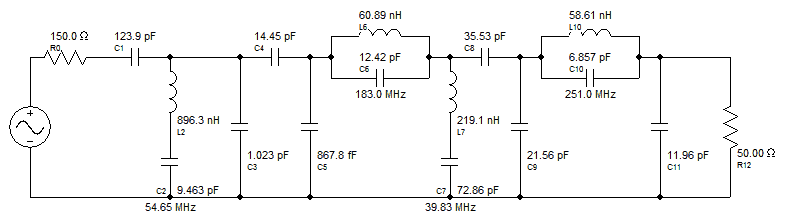

Impedance Matched Zigzag Filter and S12/S11
With only Four Inductors
Low Pass, High Pass, and Band Stop Filters
Any filter may have mismatched loads and sources matched up by adding a coupled coil transformer anywhere in the matched network, and applying a Norton transformation to the transformer. Adding a transformer to a network also blocks frequencies at DC and infinity, so if these frequencies must be passed, the transformer matching scheme will not work.
Transformers are added by right clicking any component in the network, and selecting Add New and Transformers from the pop-up window.