
Chebyshev Type I Filters
The Chebyshev Type I Filter is the filter type that results in the sharpest pass band cut off and contains the largest group delay. The most notable feature of this filter is the ripple in the pass band magnitude.
A standard Chebyshev Type I Filter's pass band attenuation is defined to be the same value as the pass band ripple amplitude. However, FilterSolutions allows the user the option of selecting any pass band attenuation in dB's that will define the filters cut off frequency.
FilterSolutions also offers the user the option of placing user-defined zeros in the stop band.
Derivation:
The characteristic equation of the Chebyshev I filter is:
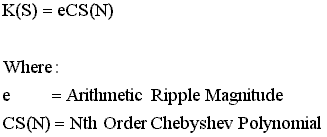
Stop band zeros may be placed anywhere on the JW axis outside the stop band or anywhere on the real axis. To enter real zeros, add the suffix "re" to the frequency value to indicate real. A more generalized expression is used to create Chebyshev filters with stop band zeros
Asymmetrical Band Pass filters
In the case of asymmetrical band pass filters, the low pass prototype cannot be used. The characteristic equation is replaced with a more generalized equiripple function.
Stop Band Zeros
If zeros are assigned to the filter stop band, the zeros are placed in polynomial form in the denominator of the K(S) characteristic equation, and the Chebyshev polynomial in the K(S) numerator is replaced with a more general equiripple equation.
Constricted Equiripple
The performance of Chebyshev I filters (and also Elliptic filters) may sometimes be improved by constricting the equiripple to a percentage of the passband near to the cutoff frequency. FilterSolutions provides for a "Constrict Equiripple" function to accomplish this. If the passband performance away from the cutoff frequency is not an issue, it is sometimes possible to reduce the required order of the filter by constricting the ripple.
See Constricted Equiripple Passbands in the Help for more information and examples.