
Frequency Asymmetrical Band Pass Filters
Asymmetrical filters are band pass filters are created using a different orders for the high pass and low pass parts of the filters. In the case of Chebyshev I1, Chebyshev II, Hourglass and Elliptic filters, the low pass and high pass orders must both be odd in order to implement with passive or tx line filters.
-
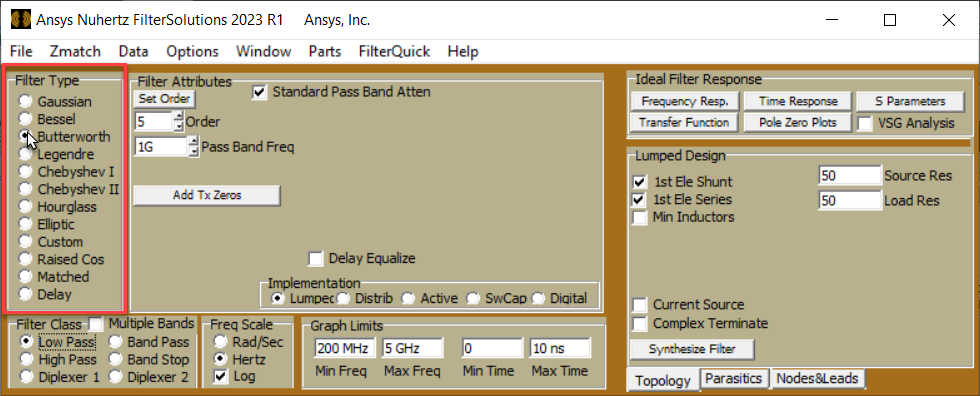
Select a filter type in the Filter Type group box.
-
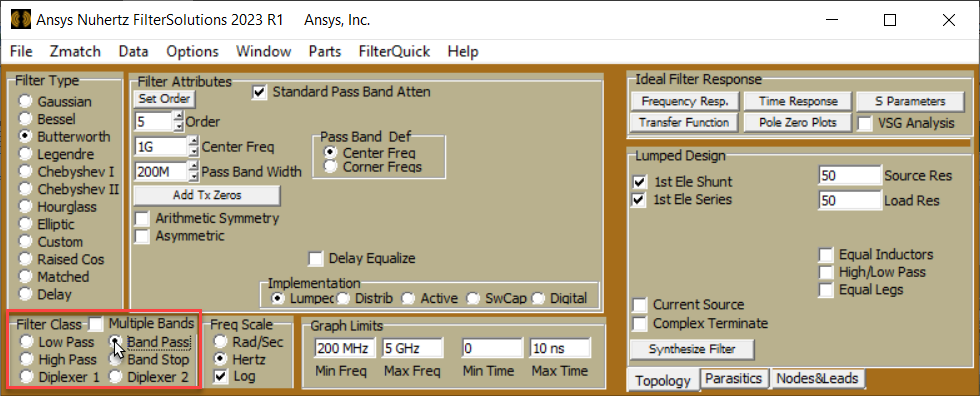
Select Band Pass in the Filter Type group box.
-
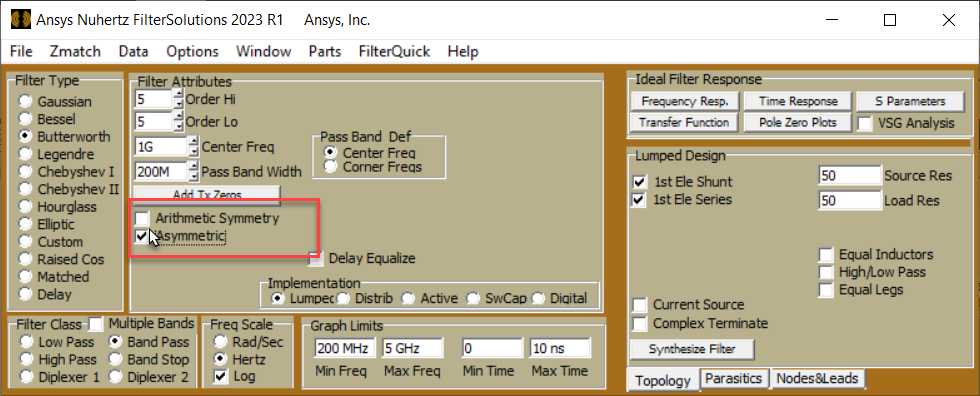
Select Asymmetric in the Filter Attributes group box.
-
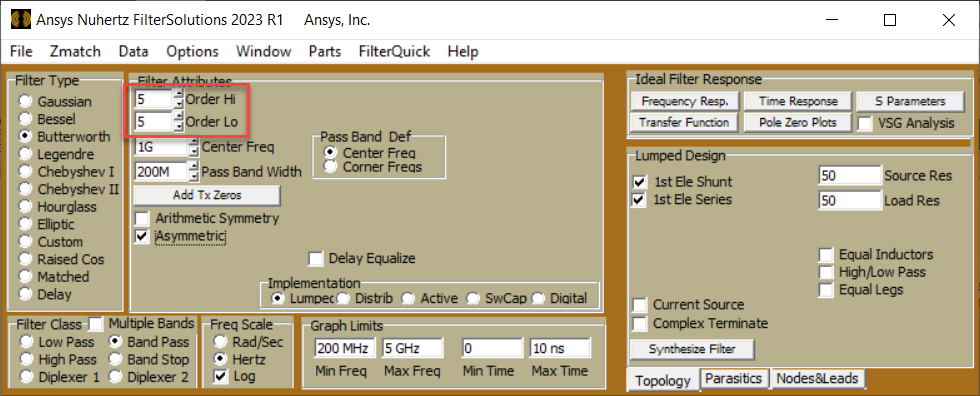
Enter the desired low pass and high pass orders into the respective Order Lo and Order Hi text boxes.
Parametric Filters
Frequency asymmetrical band pass filters with an odd total order (one side even and one side odd) are synthesized through a processes known as parametric synthesis. By necessity, such even/odd order filters synthesized though a parametric process have a reflection zero on the real frequency axis. Butterworth , Chebyshev I, Chebyshev II, and Elliptic filters support a parametric synthesis. Other filter types are not supported in their parametric form at this time
Source Resistor Restrictions and Compensation
The source resistor specification for passive and distributed filters has the effect of setting the reflection coefficient that would be a matching equivalent to that found in a symmetrical filters. The result is that the calculated source resistance is not the same as the specified source resistance. The Set Source Res switch in the Lumped control panel on the right will, if displayed, reset the source resistance using one or more Norton transformations and preserve the reflection coefficient, but will increase the component count of the filter in that Norton transforms require additional components. The Set Src Res switch found directly below the asymmetric switch will attempt to recompute the filter to achieve the desired source resistance without adding any new components, but will result in a reflection coefficient mismatch.
Setting the Stop Bands
Stop band filters of Chebyshev II, Hourglass, and Elliptic may have their high pass and low pass leg stop bands set individually by selecting the respective "Low Stop Ratio" and "High Stop Ratio" text entries. In the case of Elliptic filter, the stop band attenuation may be selected independently for both high pass and low pass legs.
Figure 1 is an example of a frequency asymmetrical Elliptic filter, 5th order low pass, 11th order high pass filter with the low pass and high pass legs set to 40dB and 80dB of attenuation respectively.
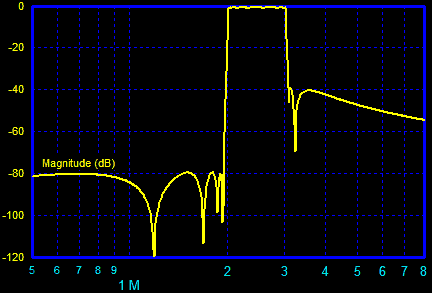
Figure 1: Frequency Asymmetric Elliptic Filter