
Series Quadruplet Resonators
Even pole Half Band Elliptic filters may be realized with ring resonators or miniaturized hairpins by cross coupling the first and last resonator in each quadruplet of a cascaded set of quadruplets. Each cross coupling implements a transmission zero in the filter being implemented. Table 1 below shows the coupling matrix of an eight pole cascaded quadruplet filter. Note the cross couplings between resonators 1 and 4 (-0.0250556), and resonators 5 and 8 (-0.0156019 ).
0 0.0809627 0 -0.0250556 0 0 0 0
0.0809627 0 0.0776943 0 0 0 0 0
0 0.0776943 0 0.0514389 0 0 0 0
-0.0250556 0 0.0514389 0 0.0556118 0 0 0
0 0 0 0.0556118 0 0.0542574 0 -0.0156019
0 0 0 0 0.0542574 0 0.0716122 0
0 0 0 0 0 0.0716122 0 0.0833026
0 0 0 0 -0.0156019 0 0.0833026 0
Table 1: 8 Pole Quadruplet Coupling Matrix
Designing Cascaded Quadruplet Resonator Filters
It is not physically possible to implement all of the transmission zeros in Elliptic filters above 4 poles in a cascaded quadruplet topology. Therefore, "Half Band Ripple" is automatically selected in order to set the maximum number of transmission zeros possible that can be implemented in the stop band by cascaded quadruplet topology. The "Half" in "Half Band Ripple" refers to utilizing roughly half of the number of transmission zeros that a standard elliptic filter normally requires. FilterSolutions will synthesize a flat stop band with the remaining half of transmission zeros and implement them as cross couplings in each quadruplet of a cascaded quadruplet resonator filter. Table 1 above shows an 8 pole Half Band Ripple filter with two of the normal 4 stop band zeros of a standard Elliptic stop band. Note that equally terminated 8 pole Elliptic filters utilize only 3 transmission zeros.
Single Point Ripple Stop Bands
Cascaded quadruplet resonator filters may be simplified somewhat by selecting, Single Point Ripple to place all stop band zeros at the same point above and below the pass band. Doing this forces the filter to be physically symmetric permits the tuning and optimizing to utilize half the number of variables as a flat stop band filter. This in turn makes the tuning and optimizing faster and more reliable. The downside is that single point ripple filters may require more poles to be as effective as flat stop band filters.
Cascaded Quadruplet Topology
Figure 2 below shows the physical topology of a 10 pole, flat stop band cascaded quadruplet filter. Note that resonators 2 and 5 are cross coupled, and 6 and 9 are cross coupled. Since 10 is not divisible by 4, two single resonator end pieces are utilized to bring the total number of resonators up to 10.
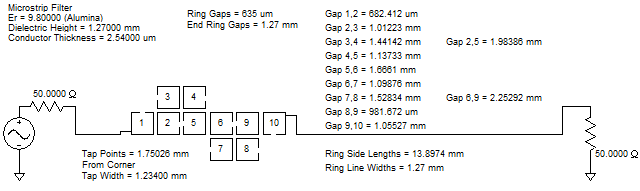
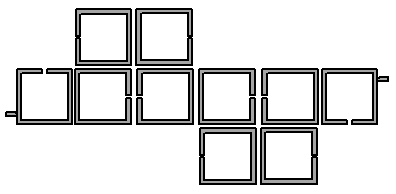
Figure 2: 10 Pole Cascaded Quadruplet Topology
EM and Circuits Analysis
Cross coupled micro strips are notoriously inaccurate to circuits simulate, especially when implemented with miniaturized hairpins. It is therefor very necessary to tune and optimize the electromagnetic response in order to produce a viable design. A 4 pole single stage quadruplet usually produces a good optimized EM response, but 6 poles and above may produce less than desirable optimized EM response, especially when miniature hairpins are used. The designer should consider the quality of the optimized EM response when choosing a topology to implement.
EM Considerations
Higher order cascaded quadruplet resonator filters generally utilize deep stop bands. If deep stop bands are a design priority, be sure to use an EM simulator that accurately simulates deep stop bands. If deep stop band accuracy is not a priority, then the designer may consider optimizing the pass band only, and let the stop bands fall wherever they land. Stop band goals may be removed by manually removing them following the export, or in the FilterSolutions export page, if goal editing is supported.