
Tx Spectral Profile
The following are the Tx Spectral Profiles for waveform modulations for Emitter:
Periodic Clock
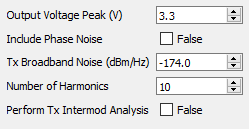
Output Voltage Peak (V): The peak power.
Include Phase Noise: Enable/disable phase noise in the broadband noise model of the transmitter spectrum. The phase noise decreases by 20 dB/decade.
Tx Broadband Noise (dBm/Hz): The amplitude of the radio's broadband power density spectrum. Tx broadband noise levels are specified in terms of dBm/Hertz. The average power level of the broadband noise should be input here. EMIT then computes the peak broadband noise level within a receiver's tuned channel when calculating the EMI Margin. The minimum broadband noise in EMIT is limited to the thermal noise floor of a 50-ohm system at room temperature which is -174dBm/Hz. Values smaller than that cannot be entered here.
Number of Harmonics: The number of harmonics (including the fundamental) included in the Tx Spectral Profile computed by EMIT. Since this includes the fundamental, the number of harmonics in the spectral profile is one less than this setting. Note that by this convention, the Nth harmonic has harmonic order (N+1).
The following shows the additional options for Periodic Clock modulation when Perform Tx Intermod Analysis is set to True.
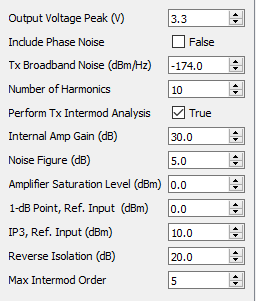
Internal Amp Gain (db): Define the in-band gain of the amplifier in dB.
Noise Figure (dB): The amplifier's noise figure in dB. The noise figure is used to calculate the broadband noise added by the amplifier
Amplifier Saturation Level (dBm): Specifies an input power level for which EMIT will consider the amplifier saturated. When an amplifier is saturated, EMIT flags it as such in the results and does not trace the input signal any further. The saturation level cannot be set lower than the 1-dB Point.
1-dB Point Ref. Input (dBm): The amplifier's 1-dB compression point referred to the input of the amplifier.
IP3, Ref. Input (dBm):The amplifier's third order intercept point referred to the input of the amplifier.
Reverse Isolation (dB): This is the amplifier's reverse isolation. The reverse isolation of an amplifier is a measure of how well a signal applied to the amplifier's output is "isolated" from its input. It is equivalent to the S12 S-parameter.
Max Intermod Order: Specifies the highest order of intermodulation product that EMIT will calculate for the amplifier.
Spread Spectrum Clock

Output Voltage Peak (V): The peak power.
PRBS

Output Voltage Peak (V): The peak power.
PRBS (Periodic)
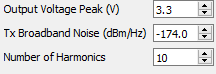
Output Voltage Peak (V): The peak power.
Tx Broadband Noise (dBm/Hz): The amplitude of the radio's broadband power density spectrum. Tx broadband noise levels are specified in terms of dBm/Hertz. The average power level of the broadband noise should be input here. EMIT then computes the peak broadband noise level within a receiver's tuned channel when calculating the EMI Margin. The minimum broadband noise in EMIT is limited to the thermal noise floor of a 50-ohm system at room temperature which is -174dBm/Hz. Values smaller than that cannot be entered here.
Number of Harmonics: The number of harmonics (including the fundamental) included in the Tx Spectral Profile computed by EMIT. Since this includes the fundamental, the number of harmonics in the spectral profile is one less than this setting. Note that by this convention, the Nth harmonic has harmonic order (N+1).