
TRL Lange Coupler
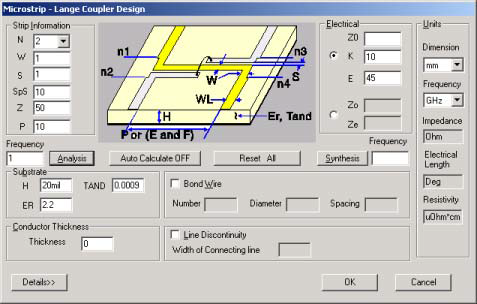
|
Keyword |
Default |
Unit |
Description |
|
N |
Req (Phys) |
m |
Number of strips (2, 4, or 6) |
|
W |
Req (Phys) |
m |
Spacing between conductors |
|
S |
Req (Phys) |
m |
Spacing between strips |
|
Sps |
10 |
|
Number of substrips used in the analysis. Substrips/strip ´ number of strips £ 60 |
|
Z |
50 |
ohm |
Connecting line impedance to account for impedance change from feed line to coupler |
|
P |
Req (Elec Opt 2) |
m |
Physical length of the coupler |
|
K |
Req (Elec Opt 1) |
dB |
Coupling coefficient (positive) |
|
Z0 |
Req (Elec Opt 1) |
ohm |
Impedance of the coupled lines |
|
Ze |
Req (Elec Opt 2) |
ohm |
Even-mode impedance of the coupled lines |
|
Zo |
Req (Elec Opt 2) |
ohm |
Odd-mode impedance of the coupled lines |
|
E |
0 |
deg |
Electrical length of the coupler |
|
Frequency |
0 |
Hz |
The frequency at which the quasistatic calculations are performed and reused at other analysis frequencies |
|
H |
Required |
m |
Substrate thickness |
|
Er |
Required |
|
Relative dielectric constant |
|
Thickness |
0 |
m |
Thickness of metalization |
|
TAND |
0 |
|
Dielectric loss tangent |
|
Bond Wire Number |
Required when activated |
|
Number of bond wires used to connect the interdigital strips |
|
Keyword |
Default |
Unit |
Description |
|
Bond Wire Diameter |
Required when activated |
m |
Diameter of bond wires |
|
Bond Wire Spacing |
Required when activated |
m |
Spacing between bond wire centers |
|
Line Disc. Width |
Required when activated |
m |
Width of the connecting line to account for the impedance discontinuity in the calculations |
Synthesis of a Lange coupler proceeds by first selecting the number of strips for the appropriate structure. Two options exist for synthesis:
— Specify impedance, Z0, and the coupling coefficient, K.
— Specify the even-mode impedance, Ze, and the odd-mode impedance, Zo.
- The substrate parameters H, and ER must be entered prior to clicking Synthesis. The width of the strips, Width, and the spacing between them, Spacing, is computed. Also, the alternate electrical option set is computed. For example, entering Z0 and K computes Ze and Zo.
- For analysis, the parameters Width, Spacing, H, ER and either PhysicalLength or Frequency must be entered prior to clicking Analysis. The electrical properties, Z0, K, Zo, and Ze is computed.
- Conversion from electrical length, E, to physical length, P, can be performed by entering a value for E and the frequency, Frequency. Click Synthesis to compute P. Similarly, to convert from physical length to electrical length, enter values for P and Frequency and click Analysis to compute E.
A dielectric substrate is defined by the parameters H, ER, and TAND. The substrate is assumed to be lossless unless TAND is specified and greater than zero.
The default conductor used for analysis is gold whose resistivity is 2.44 mohm-cm. The thickness of the metal can be specified using the Thick parameter in the substrate group. The calculation uses the thickness for loss and impedance calculations.
A frequency sweep can be performed to determine the response of the coupler over frequency. Type Start Stop Step (e.g., 4 6 5) and click Analysis.
To select the Lange coupler, select TRL on the Product menu, select Microstrip, and click Lange Coupler. Set the units to mil and GHz. Enter the following parameters for synthesizing a 4 strip, 3-dB coupler at 10 GHz:
|
Number of Strips, N: |
4 |
|
Impedance, Z0: |
50 ohms |
|
Coupling, K: |
3 dB |
|
Center Frequency: |
10 GHz |
|
Substrate thickness, H: |
25 mil |
|
Dielectric constant, ER: |
10 |
|
Metal Thickness, Thick: |
0.2 mil |
Click Synthesis to determine the coupled line parameters:
|
Width, W |
1.6545 mil |
|
Spacing, S |
2.0000 mil |
|
Odd-mode impedance, Zo: |
20.68 ohms |
|
Even-mode impedance, Ze: |
120.91 ohms |
***** LANGE SYNTHESIS *****
COUPLING IMPEDANCES (OHMS) SUBSTRATE FULL STRIPS
DB EVEN ODD COUPLER ER H(mils) NO. T(mils) W(mils) S(mils)
3.00 120.91 20.68 50.00 10.00 25.0000 4 0.20000 1.6545 2.0000
To include the effects of a bond wire and connecting
line parasitics, enter the following:
|
Bond Wire |
Yes |
|
Number |
3 |
|
Diameter |
.8 mil |
|
Spacing |
2 mil |
|
Line Discontinuity |
Yes |
|
Width |
24.5 mil |
Clicking Analysis yields the following:
***** LANGE ANALYSIS *****
SUBSTRATE:
THICKNESS = 25.0000 mils
DIELECTRIC CONSTANT = 10.0000
LOSS TANGENT = 0.00000
STRIPS:
NUMBER = 4
WIDTH = 1.6545 mils
SPACING = 2.0000 mils
THICKNESS = 0.2000 mils
SUBSTRIPS = 10
PARASITICS:
NO. PARALLEL WIRES = 3
BOND WIRE DIAMETER = 0.8000 mils
WIRE SEPARATION = 2.0000 mils
WIDTH OF 50 OHM LINE = 24.5000 mils
W/H =0.066181 S/H =0.079999
W/H =0.071646 S/H =0.074534 EFFECTIVE VALUES DUE TO FINITE THICKNESS
*** DC CHARACTERISTICS
Z(0) = 50.00 Ohms
ZOE OHMS ZOO OHMS COUP DB Z(0) EFFKE EFFKO VE M/SEC VO M/SEC
131.56 22.81 3.04 54.79 6.378 5.502 1.1870E+8 1.2781E+8
*** CHARACTERISTICS WITH DISPERSION
CENTER FREQUENCY = 10000.0 MHZ
ZOE OHMS ZOO OHMS COUP DB Z(0) EFFKE EFFKO VE M/SEC VO M/SEC
134.08 23.18 3.03 55.75 6.380 5.510 1.1869E+8 1.2771E+8
EVEN MODE ATTENUATION ODD MODE ATTENUATION
db/in db/in
0.6087 2.1903 DIELECTRIC + CONDUCTOR
EFFECTIVE DIELECTRIC CONSTANT OF COUPLER = 5.9371
ESTIMATED COUPLING LENGTH = 121.098 mils
INDUCTANCE PER CROSSOVER LOCATION = 0.12526 nH
RESISTANCE PER CROSSOVER LOCATION = 0.04920 Ohms
*** RESPONSE WITH DISPERSION AND PARASITICS
FREQ. REFL. VSWR RET LOSS COUPL. PHASE THRU LOSS PHASE ISOLAT
(MHz) COEFF (dB) (dB) (Deg) (dB) (Deg) (dB)
10000 0.068 1.15 -23.3 3.23 -0.6 -3.11 -90.2 -24.66
DUE TO PARASITICS, THE CENTER FREQUENCY HAS SHIFTED DOWN FROM 10000 MHZ
To perform a frequency analysis from 4 GHz to 12 GHz in steps of 1 GHz, type 4 12 1 in the Frequency group box. Then add coupling length P = 121.098 mil. The last part of the output contains the analysis at each frequency. The 10 GHz center frequency analysis point is used to compute the quasistatic characteristics and reused at each analysis frequency.
FREQUENCY ANALYSIS OF COUPLER
FREQ. REFL. VSWR RET LOSS COUPL. PHASE THRU LOSS PHASE ISOLAT
(MHz) COEFF (dB) (dB) (Deg) (dB) (Deg) (dB)
4000 0.078 1.17 -22.1 5.99 42.2 -1.56 -45.6 -23.92
5000 0.081 1.18 -21.8 4.89 33.7 -2.02 -54.5 -23.42
6000 0.081 1.18 -21.8 4.17 26.0 -2.42 -62.5 -23.30
7000 0.079 1.17 -22.1 3.70 18.9 -2.74 -69.9 -23.41
8000 0.076 1.16 -22.4 3.41 12.2 -2.97 -76.9 -23.69
9000 0.072 1.16 -22.8 3.26 5.7 -3.10 -83.6 -24.11
10000 0.068 1.15 -23.3 3.23 -0.6 -3.11 -90.2 -24.66
11000 0.065 1.14 -23.8 3.33 -7.1 -3.02 -96.9 -25.34
12000 0.060 1.13 -24.4 3.56 -13.8 -2.81 -103.8 -26.03
Electrical Length [Eeff=(Effo+Effe)/2] = 35.78 deg