
Good Fit at DC
The quality of the fit at DC is particularly important, not least because it determines the operating point in a circuit simulation. In fact, the accuracy of the fit to the S-parameters often needs to be extremely high, especially in signal integrity applications. Consider, for example, a signal bus. The elements of the impedance matrix (the Z-parameters) of a bus tend to have a 1/f dependence, diverging at DC. This happens when the dielectric separating the signal and ground planes is assumed to have zero conductivity, which is often a valid assumption. Or, if the dielectric is not considered perfect, the DC impedances are still very large. However, the S-parameters must remain ≤1. This means that the mapping between S and Z,

where z0 is the characteristic impedance, amplifies the tiniest errors in S to large errors in Z (following figure). So, a state-space model must either match the DC point data with extremely high accuracy, or, if there is no DC point, the fit to S must be such that the corresponding Z diverges at DC. Otherwise, there is a small leakage current between the signal and ground planes. The FastFit algorithm ensures that Z matches the DC point if one is available. If not, it checks whether it is possible to make Z diverge without affecting the quality of the fit at non-zero frequencies, and if so perturbs the model slightly so as to ensure this.
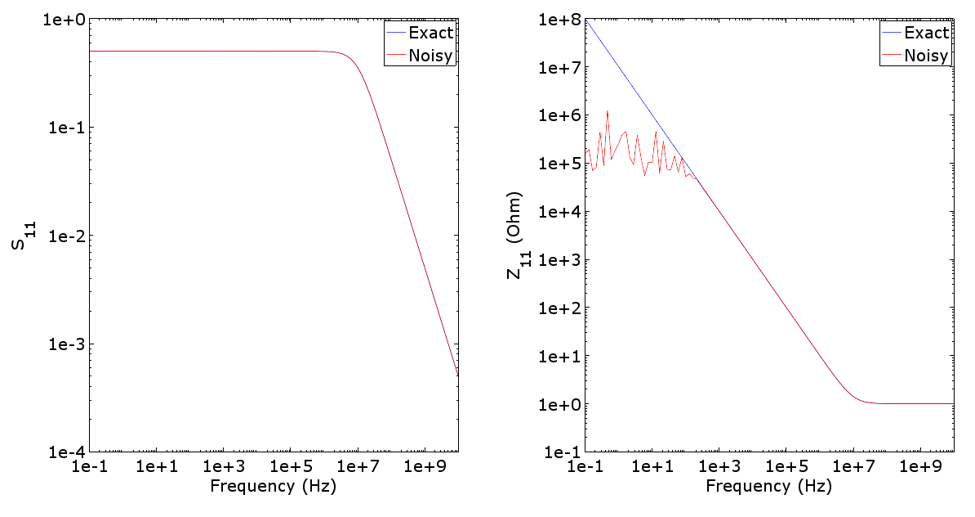
TWA also tries to ensure a good fit a lower frequencies, though it does not match the DC point, nor ensure divergence if there is no DC point.
When passivity is enforced, the fit is perturbed and this may lead to a poor low-frequency fit. This problem has been recently resolved, however, with a fitting method called IFPVLF.
The various conditions mentioned above make state-space fitting a difficult computational problem, for which there is no known closed-form mathematical solution. Ansys has developed increasingly sophisticated algorithms for state-space fitting over the years. For the sake of backward compatibility, and because an older algorithm might, in rare cases, yield better results than the latest algorithm, nearly all algorithms and their options are still accessible. The main goal of this technical note is to guide the user through this maze.