
AMI Repeaters
A repeater is a device placed in the middle of a channel to compensate for loss. An AMI repeater model consists of a Receiver (Rx) model on one AMI channel setup and a Transmitter (Tx) model on a second channel setup. The pins on the Rx and Tx are paired to define the repeater. The repeater compensates for channel loss, reducing the bit error rate of the system.
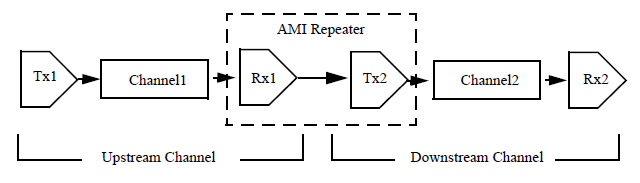
In the preceding figure, the upstream channel of the repeater consists of:
- The upstream Transmitter model, both algorithmic and analog portions (Tx1).
- The physical channel (Channel1).
- The upstream Receiver model, both algorithmic and analog portions (Rx1).
A single impulse response characterizes the incoming (upstream) analog channel of the repeater, which includes the upstream Tx analog model, the physical channel, and the upstream Rx analog model.
In the preceding figure, the downstream channel of the repeater consists of:
- The downstream Transmitter model, both algorithmic and analog portions (Tx2).
- The physical channel (Channel2).
- The upstream Receiver model, both algorithmic and analog portions (Rx2).
A second impulse response characterizes the outgoing (downstream) channel, including the downstream Tx analog model, the physical channel, and the downstream Rx analog model.
A repeater model is specified in a single IBIS library (.ibs) file that includes both the input and output models. The .ibs file identifies the pins on the Rx and Tx that are paired to define the repeater. See AMI Repeater Properties for information on setting the AMI Repeater properties.
Here are some details about the AMI repeater components:
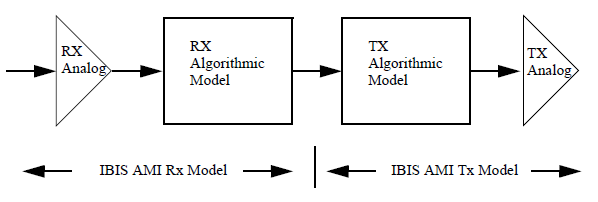
The signal flow in a repeater model is from Rx Analog to Rx algorithmic to Tx algorithmic to Tx Analog.
The Rx and Tx algorithmic models represent equalizers, clock data recovery (CDR) circuits, or pre-emphasis inside the devices.
The analog part of the Rx model represents the input termination at the device input. Looking on the Rx analog portion, the Rx algorithmic block is assumed to have an infinite input impedance. The analog part of the Tx model represents the output impedance at the device output. Looking on the Tx analog portion, the Tx algorithmic block is assumed to have the output characteristics of an ideal voltage source. In AMI repeater simulations, both Rx and Tx analog models are assumed linear and time-invariant.
A Repeater can be either a Redriver or a Retimer.
AMI Redrivers
A redriver equalizes the upstream channel and retransmits it to the downstream channel. The output signal is continuously driven by the input signal and no retiming is performed when the redriver retransmits the signal. The redriver Rx passes its equalized output waveform directly to the Tx half of the repeater. The redriver boosts the signal, improving the quality of the signal at the link and at the output of the final receiver.
In a redriver, both algorithmic models can also implement the AMI_GetWave function.
See also:
AMI Time Domain Simulation with AMI Redriver or Retimer
AMI Statistical Simulation with AMI Redriver or Retimer
AMI Retimers
A retimer contains both a CDR and a generator for clock times in its AMI_GetWave function. The retimer CDR uses the clock times to sample the Rx equalized waveform and generate a digital stimulus for the Tx half of the repeater. The use of a retimer significantly improves the signal quality at each repeater stage.
In a retimer, the Rx algorithmic model must implement AMI_GetWave and the function must return clock times. The retimer Tx Algorithmic model can also implement AMI_GetWave.
For a retimer, the simulator generates a digital input to the retimer Tx by sampling the Rx AMI_GetWave output at each (tick + UI/2). the digital stimulus has vlow of -0.5V and vhigh of +0.5V.
AMI Time Domain Simulation with AMI Redriver or Retimer
In time domain simulation, the waveform from upstream channel 1 is propagated to downstream channel 2.
AMI Redriver Time Domain Simulation
Here is the sequence of operations for an AMI redriver link.
- The solver obtains the impulse response of the upstream analog channel 1.
- The impulse response is sent through the AMI_Init functions of the upstream transmitter Tx1 and receiver Rx1.
- The solver obtains the impulse response of the downstream analog channel 2.
- The impulse response is sent through the AMI_Init functions of the downstream transmitter Tx2 and receiver Rx2.
- The solver performs AMI time domain simulation of upstream channel.
- The simulator uses the output on the upstream receiver (Rx1out) as the input to the downstream transmitter (Tx2in). Any AMI_GetWave function in Rx1 or Tx2 is ignored.
- The solver performs AMI time domain simulation of the downstream channel.
AMI Retimer Time Domain Simulation
Here is the sequence of operations for an AMI retimer link.
- The solver obtains the impulse response of the upstream analog channel 1.
- The impulse response is sent through the AMI_Init functions of the upstream transmitter Tx1 and receiver Rx1.
- The solver obtains the impulse response of the downstream analog channel 2.
- The impulse response is sent through the AMI_Init functions of the downstream transmitter Tx2 and receiver Rx2.
- The solver performs AMI time domain simulation of upstream channel.
- The solver samples the waveform output by upstream receiver Rx1 AMI_GetWave function at 0.5UI after each clock tick returned by the function. The parameter Rx_Receiver_Sensitivity controls the interpretation of a sampled bit as logic 1 or logic 0; see the IBIS Specification (AMI Analysis References) for further information.
- The sampled waveform is used to generate a new digital waveform as input to the downstream transmitter Tx1. Any AMI_GetWave function in the downstream transmitter Tx2 is ignored. The digital waveform has values of -0.5V for logic 0 and +0.5V for logic 1.
- The solver performs AMI time domain simulation of the downstream channel.