Computing Far Field Solutions in HFSS 3D Layout (General Mode Only)
To analyze the radiated fields associated with a design, first define a radiation surface. The values of the fields calculated over this surface are used to compute the fields in the space surrounding the device. This space is typically split in two regions: near field and far field. The far field region exists at more than a wavelength from an energy source.
Setting Up a Far Field Simulation
Follow these steps to add a far field solution setup to an active design.
Users can also configure a far field solution setup using a Python script, either by manually creating one or utilizing the Record Script function on the Automation tab, then importing the result to generate an Ansys ECAD database file (i.e., edb.def) source. Refer to Using a Python Script to Configure an SIwave Solution Setup.
- Open the Far Field Solution Setup window by doing one of the following:
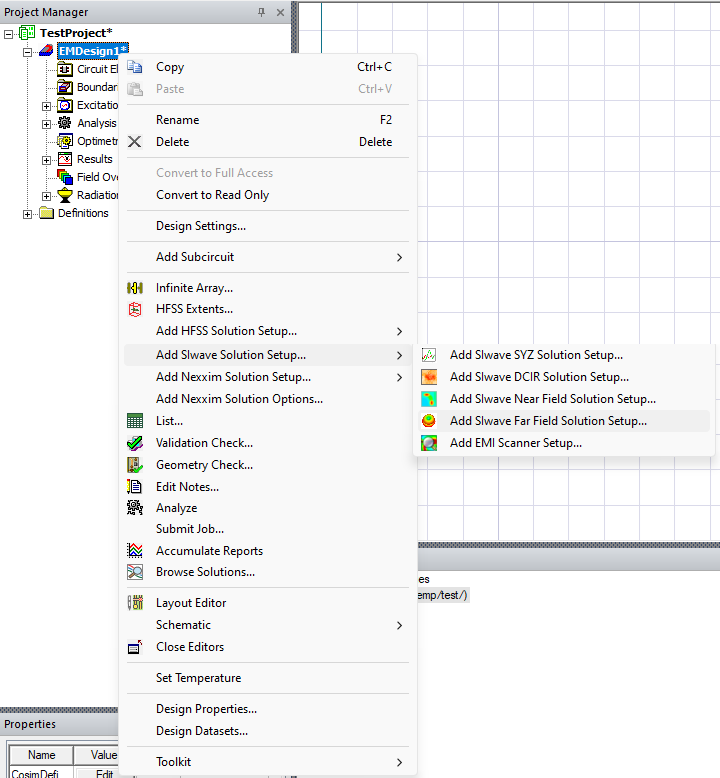
- From the Project Manager window, expand the Project Tree (e.g., TestProject). Then right-click the active design folder (e.g., EMDesign1) and select Add SIwave Solution Setup > Add SIwave Far Field Solution Setup.
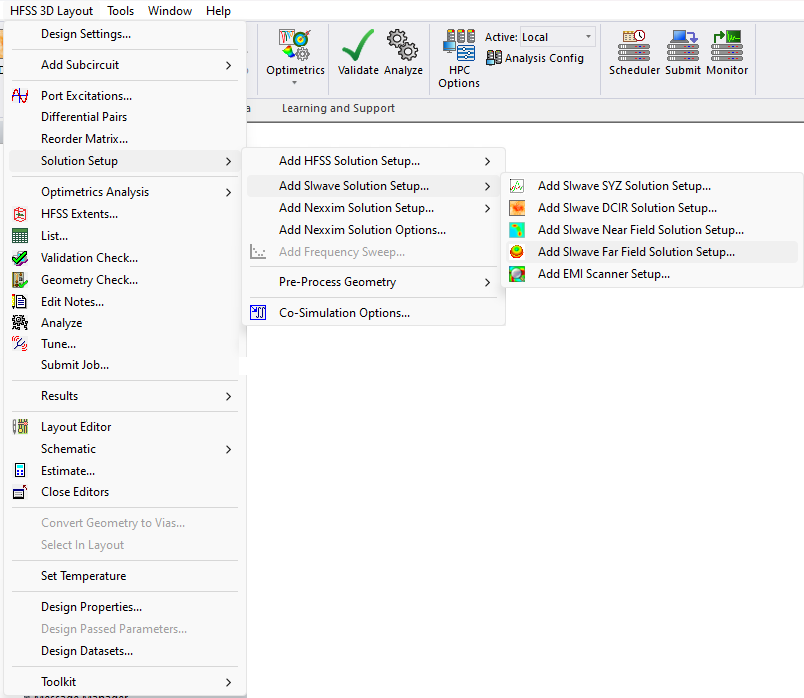
- From HFSS 3D Layout, select Solution Setup > Add SIwave Solution Setup > Add SIwave Far Field Solution Setup.
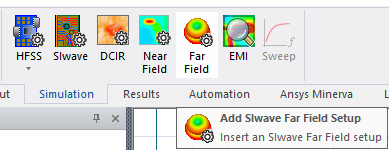
From the Simulation ribbon tab, click Far Field.
- From the Project Manager window, expand the Project Tree (e.g., TestProject). Then right-click the active design folder (e.g., EMDesign1) and select Add SIwave Solution Setup > Add SIwave Far Field Solution Setup.
-
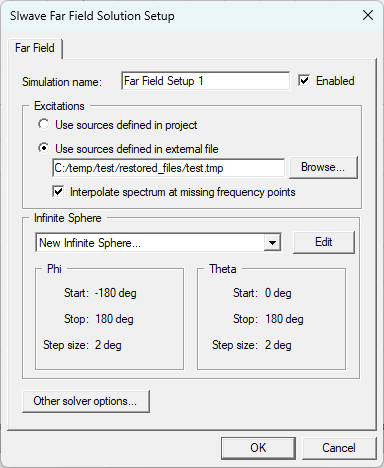
From the SIwave Far Field Solution Setup window, make selections to change the following default values.
-
Simulation name — enter a name in the field or accept the default (i.e., Far Field Setup 1).
-
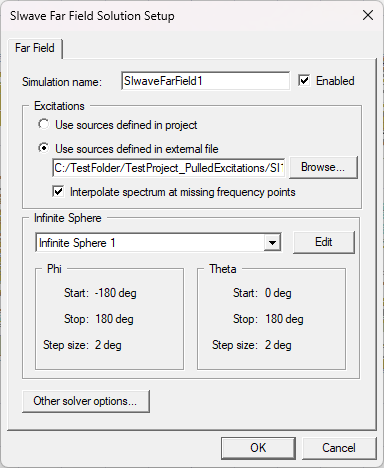
Excitations — select a source of excitations (i.e., Use sources defined in the project or Use sources defined in external file). If users select Use source defined in external file, Browse to an appropriate file and select it (e.g., test.tmp). If applicable, uncheck the Interpolate spectrum at missing frequency points box.
Note:A transient excitation source from either Circuit or HFSS 3D Layout sources can be assigned after setup is complete. Refer to Assigning a Transient Excitation.
-
Infinite Sphere — select a far field infinite sphere from the drop-down menu and click Edit to make changes to the selected infinite sphere. Alternatively, select New Infinite Sphere and click Edit to set up a new far field infinite sphere. Refer to Set Up a Far Field Infinite Sphere.
-
-
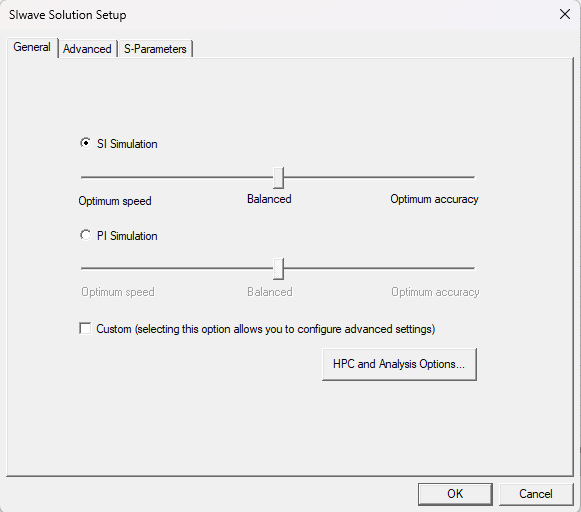
If applicable, click Other solver options to open the SIwave Solution Setup window. Otherwise, click OK to add the new far field solution setup to the active design.
The Edit Frequency Sweep window appears.
Setting Up a Frequency Sweep
Follow these steps to add a frequency sweep to a far field solution setup.
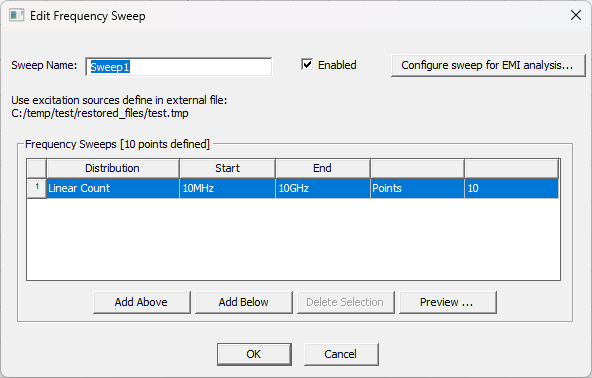
- From the Edit Frequency Setup window, make selections from the following default values:
- Sweep Name — enter a name in the field or accept the default (i.e., Sweep1).
- Enabled — checked by default to enable the sweep.
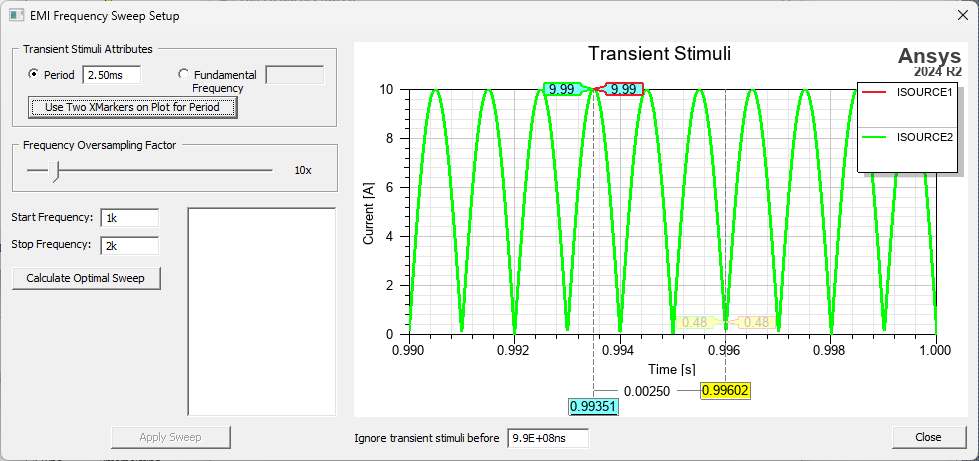
- Configure sweep for EMI analysis — click to access the EMI Frequency Sweep Setup window.Note:
EMI analysis is only available if the user selects Use sources defined in external file in the Excitations area of the SIwave Far Field Solution Setup window.
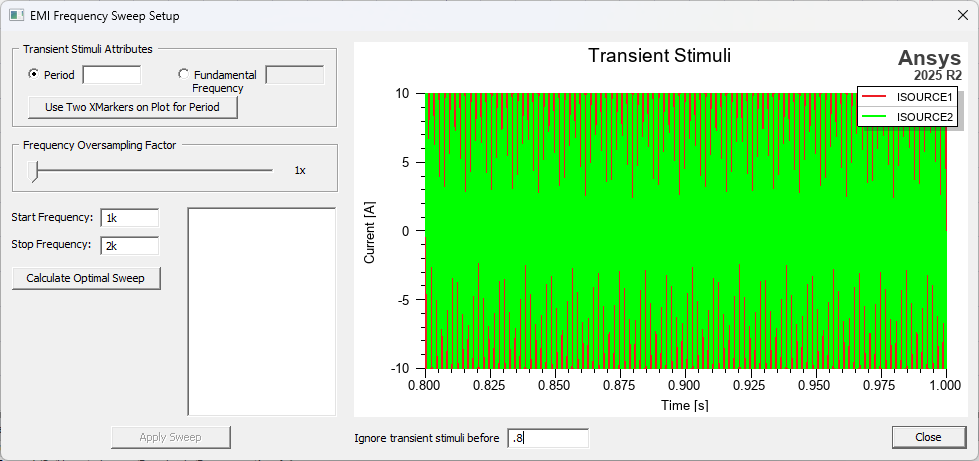
- From the EMI Frequency Sweep Setup window, make selections from the following default values:
- From the Transient Stimuli Attributes area, select Period or Fundamental Frequency and enter an appropriate value in the field (e.g., 0.01). The period is
the measured length of information (T).
The Fundamental Frequency is defined as f0 = 1/T where T is the period information.Note:
To use the Use Two XMarkers on Plot for Period function to automatically determine the period, refer to Using Two X Markers.
- Frequency Oversampling Factor – move the slider to select the frequency range sampling density (e.g., 1x). A higher oversampling factor results in more frequency points being introduced between the selected sweep start and stop frequencies, and may result in longer simulation time.
- Start Frequency — enter a value for the minimum frequency to sweep (e.g., 1k).
- Stop Frequency — enter a value for the maximum frequency to sweep (e.g., 2k).
- Calculate Optimal Sweep — generates the sweeps. They appear as a list in the field.
- Ignore transient stimuli before — enter a value to filter out any non-periodic start-up transient ripple when computing the Fourier transform during simulation (i.e., .8).Note:
Setting a value in the Ignore transient stimuli before box resets the X minimal to the entered value. The ignored time period is represented by a shaded rectangle on the plot.
- From the Transient Stimuli Attributes area, select Period or Fundamental Frequency and enter an appropriate value in the field (e.g., 0.01). The period is
the measured length of information (T).
The Fundamental Frequency is defined as f0 = 1/T where T is the period information.
- From the EMI Frequency Sweep Setup window, make selections from the following default values:
-
Click Apply Sweep to add a new sweep row to the table in the Frequency Sweeps area in the Edit Frequency Sweeps window.
- Click Close to return to the Edit Frequency Sweeps window. Add more sweeps, as appropriate.
- Back at the Edit Frequency Sweep window, make selections from the following default values in the Frequency Sweeps area:
- Distribution — select Linear or By Decade from the drop-down menu.
- Linear — the difference between start frequency and stop frequency is calculated and divided by the number of solution points.
- By Decade — distributes the number of points specified logarithmically, over each decade.
- Enter values in the Start, End, and Points fields, as appropriate.
- If applicable, click Add Above or Add Below to add additional frequency sweeps, including mixed sweep types.
- If applicable, click Delete to remove any sweeps.
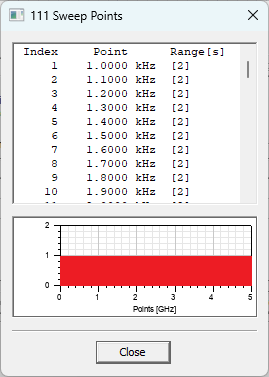
- Click Preview to open the Frequency List Preview window. Then click Close.
- Distribution — select Linear or By Decade from the drop-down menu.
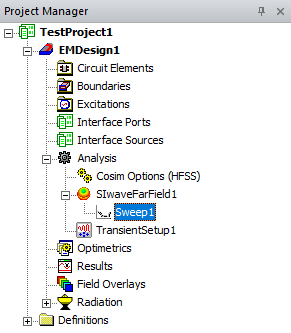
- Click OK and the sweep(s) will appear in the Project Manager window > Project Tree > active design folder > Analysis directory under the active solution setup.
Assigning a Transient Excitation
Follow these steps to select a Circuit or HFSS 3D Layout transient excitation source to use as an external source for simulation. These instructions assume the user has already set up and solved a Transient Analysis on the design with all appropriate drivers and receivers attached to ports. Transient currents flowing into each port are captured and converted to frequency-domain sources during execution of far field simulations. Users can also record these steps using the Record Script function on the Automation tab, then run the resulting Python script to set the specified excitation source. Refer to Using a Python Script to Configure an SIwave Solution Setup.
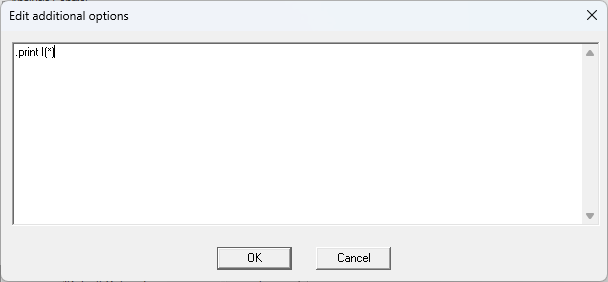
If the user intends to use a transient excitation source from either Circuit or HFSS 3D Layout sources in a far field simulation, enter: .print I(*) in the Edit additional options window. Refer to Setting Up a Transient Analysis in HFSS 3D Layout.
-
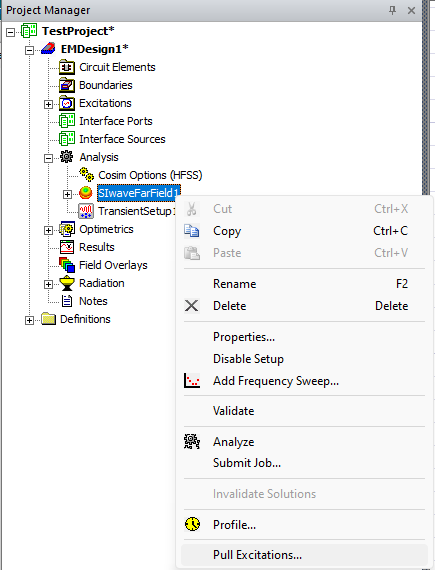
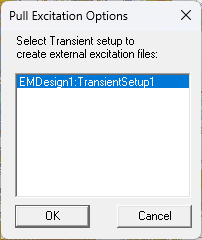
From the Project Manager window, expand the active design folder (e.g., EMDesign1) (and any subdesign) > Analysis. Then right-click the far field solution setup (e.g., SIwaveFarField1) and select Pull Excitations to open the Pull Excitation Options window.
-
From the Pull Excitation Options window, select a design to use its excitations as an external source (e.g., EMDesign1:TransientSetup1).
-
Click OK to close the Pull Excitation Options window. If the excitation is accepted, a confirmation message appears in the Message Manager window.

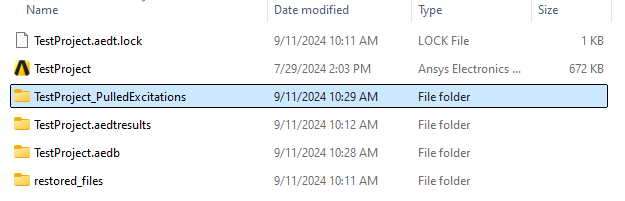
Within the same directory where the project is saved, a folder is created called <ProjectName>_PulledExcitations, which contains the newly created excitation files referred to in the Message Manager window.
From the SIwave Far Field Solution Setup window, Use sources defined in external file is now selected and the adjacent field is populated with the path to the excitations source file.
Analyzing the Design and Post-Processing
Follow these steps to analyze the new far field solution setup, then generate a report.
-
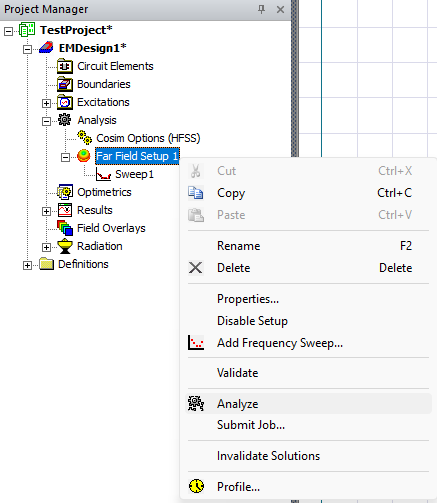
From the Project Manager window, right-click the new simulation (e.g., Far Field Setup 1) and select Analyze to run the simulation. Refer to Running Simulations.
View progress in the Progress window.

The result of the analysis is saved in the same directory as the project file.
-
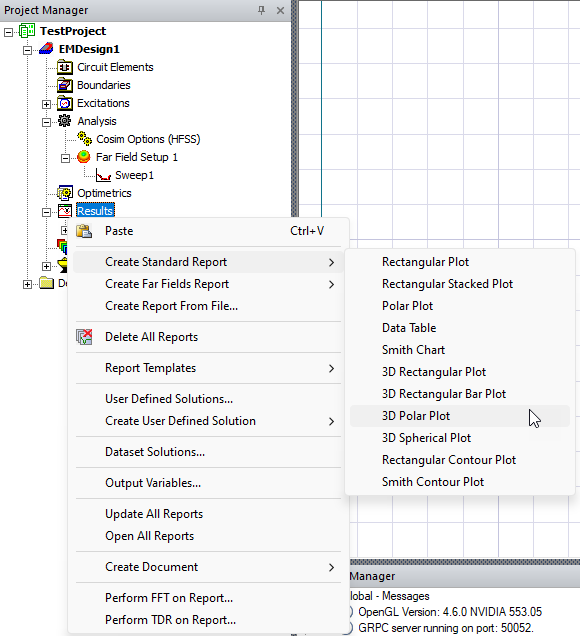
To create a report, such as a 3D polar plot report, navigate to the Project Manager window and right-click Results. Then navigate to Create Standard Report and select an appropriate report type (e.g., 3D Polar Plot) to open the Report window.
-
From the Report window, make any appropriate adjustments.
-
Ensure the correct setup and sweep are selected from the Solution drop-down menu (e.g., Far Field Setup 1 : Sweep1).
-
Ensure the correct infinite sphere is selected in the Geometry drop-down menu (e.g., Infinite Sphere 2).
-
rE is selected from the Category list.
-
-
Click New Report to generate the report. It will automatically open in the View tab.
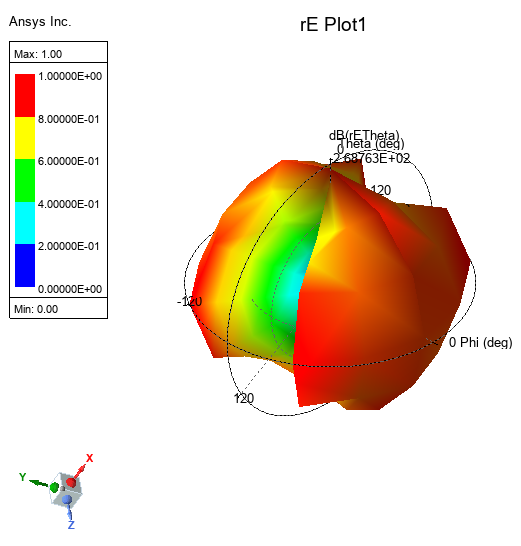
The procedure is complete.
Using Two X Markers
Follow these steps to mark two frequency points, then automatically determine the period between the frequency points.
-
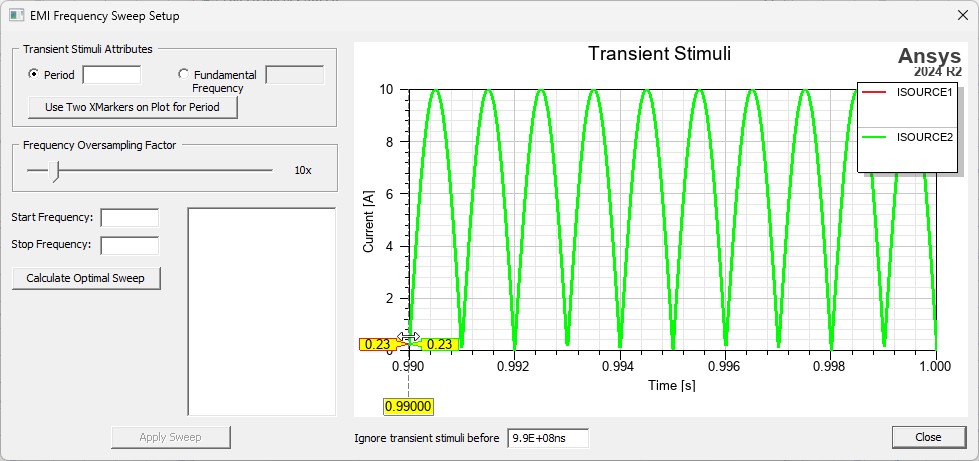
Right-click within the graph and select Add X Marker.
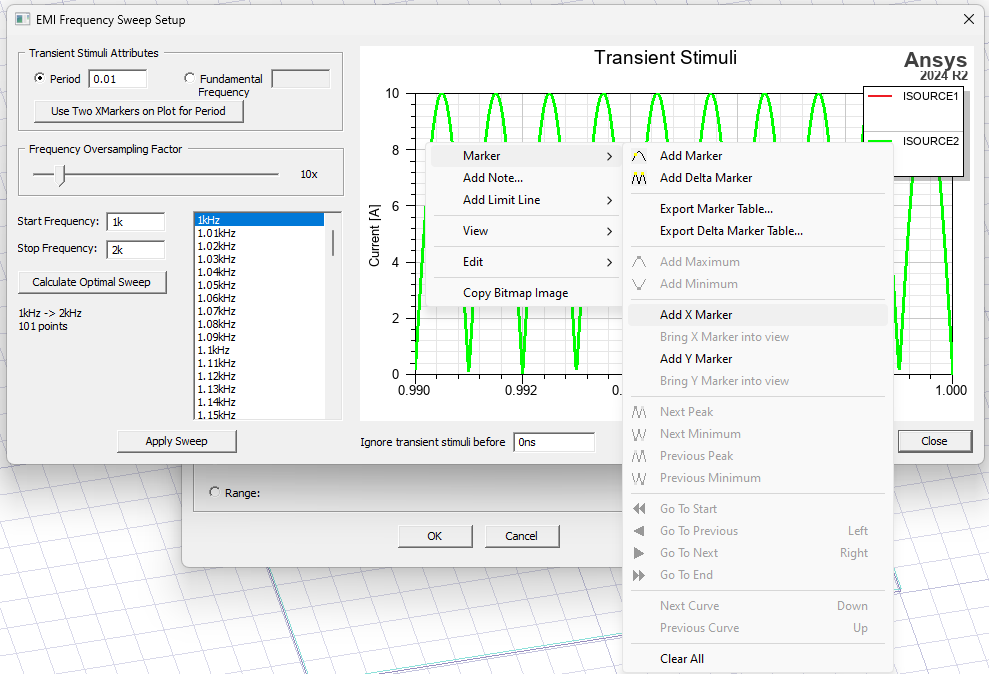
This creates the first X marker point (i.e., at X minimal, by default).
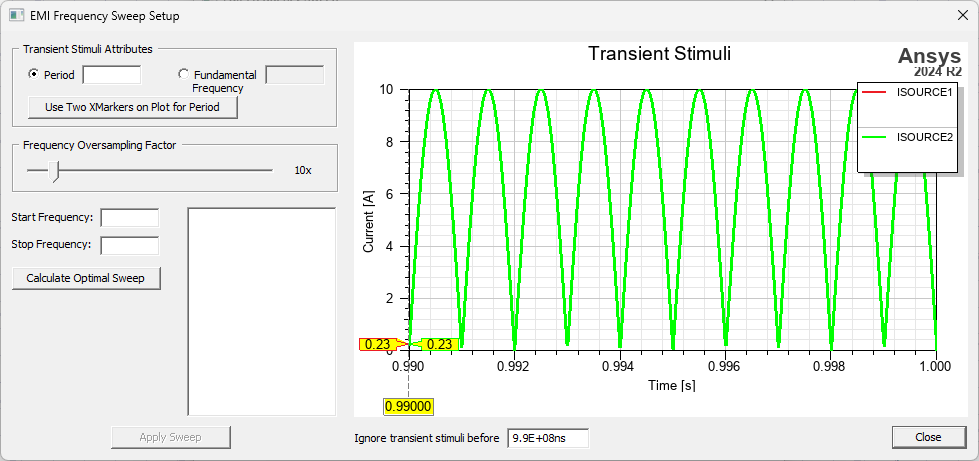
-
Hover directly over the X marker until the cursor becomes a line with two arrows. Then click+drag the X marker to the required frequency point.
-
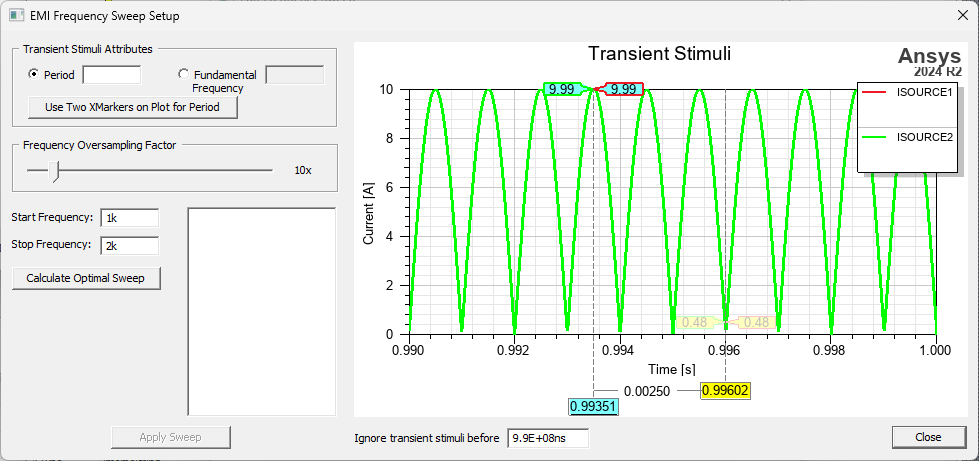
Right-click within the graph and select Add X Marker again to add a second X marker on the graphic.
-
Click+drag the second X marker to the required frequency point.
-
From the Transient Stimuli Attributes area, click Use Two XMarkers on Plot for Period. The Period box populates with the length between the user-selected frequency points (e.g., 2.50ms).