
Background - Battery Modeling Styles
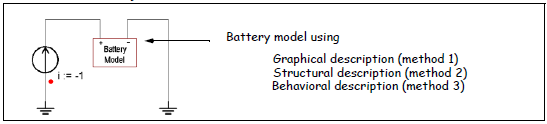
The following figure shows the basic test circuit for all of the modeling styles. In each style, the battery is replaced with an equivalent model. The current source has a value of –1A, indicating that it draws current from the battery model.
The battery model is designed as a simple circuit with two resistors and two capacitors as shown in the following circuit:
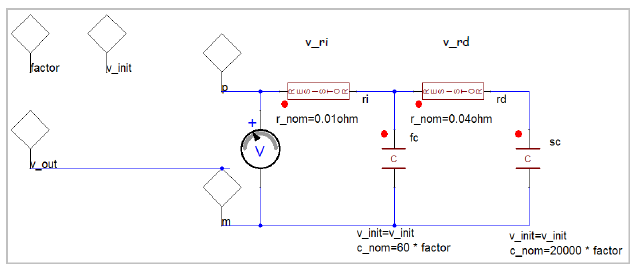
The battery model also accepts two parameters: v_init specifies the initial voltage of the battery, and factor, a parameter that expresses the capacity factor and aids in simple scaling of the battery. The internal resistance (ri=10mOhm), diffusion resistance (rd=40m), the fast capacitor (fc=60*factor), and the slow capacitor (sc=20000*factor) have constant values.
The model calculates the circuit based on the following equations:
|
v_ri = i_ri * ri d(v_fc)/dt = 1/(fc*factor) * i_fc v_rd = i_rd * rd d(v_sc)/dt = 1/(sc*factor) * i_sc |
The factor value is used to scale the two capacitances from their default value. Thus, factor is a normalized charge capacity for the battery.
See Battery Model also. Unlike the battery model in the Automotive Powernet System example, this battery model does not provide State of Charge (SoC) as an output parameter.