
Transient Cosimulation Component Interface Concept
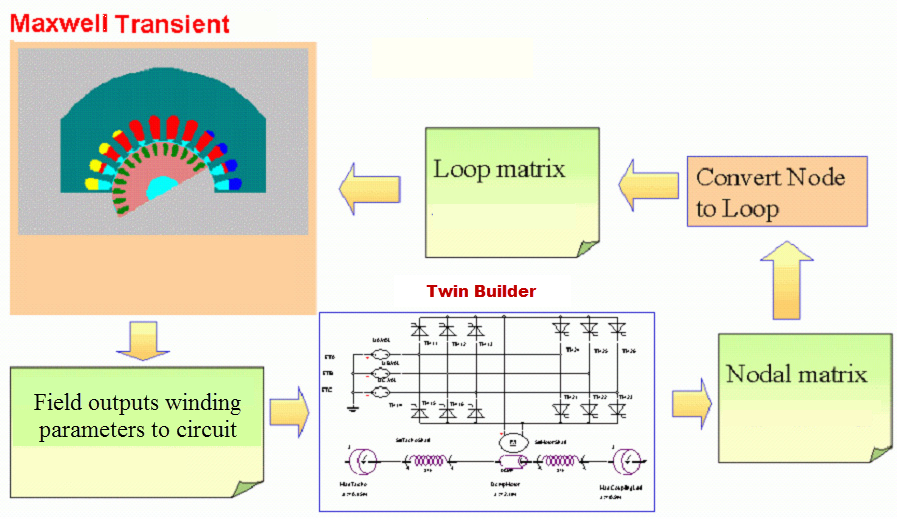
Twin Builder controls the time step during simulation and also controls the rotational speed or linear velocity of the Maxwell component.
At each time step each solver creates a drive circuit at the coupling pins looking into the other system:
- Twin Builder sees the Maxwell Winding as a Thevenin equivalent circuit with a specified source-voltage, resistance, and inductance at each time step.
- Maxwell sees the Twin Builder circuit as a Norton-equivalent circuit with a specified source-current and admittance at each time step.
- For the Mechanical coupling, The Position is imposed by Twin Builder to Maxwell and the Torque is imposed to Twin Builder by Maxwell.
During each time step, the two solvers exchange coupling matrix data using TCP/IP sockets. Since the data exchange is relatively small, the Maxwell 2D or 3D Transient and the Twin Builder transient solvers can run on different computers, as long as they have access to each other over a network.
To form a valid Norton-equivalent of the drive circuit from Twin Builder, do not directly connect an independent voltage source—or a VHDL-AMS ammeter—to a winding terminal that is connected to the ground or another winding terminal without any other components (such as a resistor) in the series.
However, the basic ammeter (select Basic Elements > Measurement > Electrical > AM: Electrical Ammeter in the Component Libraries pane) does not have such a limitation as Twin Builder automatically handles those direct connections.