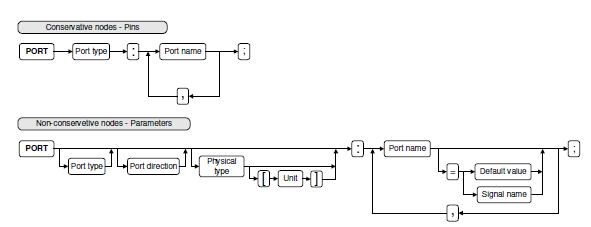
Header Information of Structural Models
The header of structural models (subsheets) contain type, direction, and name of ports. There are two types of ports: electrical and real. In addition, the header may contain the assignment of default values for the variables defined in the port list.
|
|
||
|
Port type: |
For conservative nodes: ELECTRICAL, FLUIDIC, MAGNETIC, TRANSLATIONAL, TRANSLATION_V, ROTATIONAL, ROTATIONAL_V, THERMAL For nonconservative nodes: REAL, FILE, STRING Default port type = REAL |
|
|
Port direction: |
Direction of data exchange over the nodes = { IN | OUT | INOUT }; Default = IN: The port direction is supported only for real ports (nonconservative nodes). |
|
|
Physical type |
Specifies a special data type for non-conservative nodes (for example, RESISTANCE, CAPACITANCE, ANGLE). |
|
|
Unit |
The value transferred by this parameter will be converted to this unit/subunit of the given physical type (for example, Ohm, kOhm, MOhm for RESISTANCE). The default unit is always the SI unit for the given physical type. |
|
|
Port name: |
Definition name of the node. The syntax rules for type names are valid. |
|
|
Default value |
Default value for non-conservative nodes with IN as port direction. This value will be used, if this parameter is not used in the model instance call. The initial value must be a number or arithmetical expression, which is calculable without access to other quantities. |
|
|
Signal name |
Name of the signal which is connected to a non-conservative nodes with IN or INOUT as port direction. This name must be a name of a variable or model parameter inside the structure definition. It cannot be used as default value. |
|
|
PORT electrical : T1; PORT translational : T2; PORT real in : Value = 2k; PORT real in RESISTANCE[kOhm] : R_value = 2; PORT real out : R1_I = R1.I; PORT real inout : count = count_var; |
||