
Genetic Algorithm (Random search)
Genetic Algorithm (GA) optimizers are part of a class of optimization techniques called stochastic optimizers. They do not use the information from the experiment or the cost function to determine where to further explore the design space. Instead, they use a type of random selection and apply it in a structured manner. The random selection of evaluations to proceed to the next generation has the advantage of allowing the optimizer to jump out of a local minima at the expense of many random solutions which do not provide improvement toward the optimization goal. As a result, the GA optimizer will run many more iterations and may be prohibitively slow.
The Genetic Algorithm search is an iterative process that goes through a number of generations (see image below). In each generation some new individuals (Children / Number of Individuals) are created and the so grown population participates in a selection (natural-selection) process that in turn reduces the size of the population to a desired level (Next Generation / Number of Individuals).
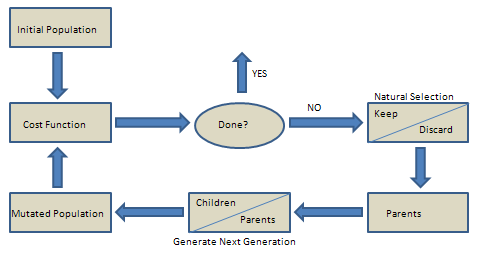
When creating a smaller set of individuals from a bigger set, the GA selects individuals from the original set. During this process, better fit (in relation to the cost function) individuals are preferred. In the elitist selection, the best so many individuals are selected, but if you turn on the roulette selection, then the selection process gets relaxed. An iterative process starts selecting the individuals and fill up the resulting set, but instead of selecting the best so many, we use a roulette wheel that has for each selection-candidate divisions made proportional to the fitness level (relative to the cost function) of the candidate. This means that the fitter the individual is, the larger the probability of survival will be.
Related Topics
Optimization Setup for Genetic Algorithm (Random search) Optimizer