
Setup Link (Transient Thermal Restart)
When starting or continuing a transient thermal analysis from a previously solved Mechanical Steady-State Thermal or Transient Thermal setup, use the Setup Link dialog box to specify the source project, source design, and other linking options.
The link between source and target designs is a one-way coupling operation. Changes you make in the target Mechanical–Transient Thermal design have no effect on the source design's results.
How to Set Up Transient Restart Linking
The following procedure assumes that you have already set up and solved a source thermal design (either steady-state and transient) and that you have already created a suitable target transient thermal design (as outlined in the Restart Requirements and Limitations section of the Transient Restart Analyses topic). Additionally, it is assumed that you have selected the Start/Continue from a previously solved setup option under the Advanced tab of the Thermal Solve Setup dialog box, and the General tab of the Setup Link dialog box is now displayed.
- If the data is to be imported from a Mechanical–Thermal design in the same project (whether steady-state or transient), complete the following substeps. Otherwise skip to step 2:
- Select Use This Project.
- Skip to step 3.
- Alternatively, if the data is to be imported from a Mechanical–Thermal design in a different project, clear the Use This Project option and complete the following substeps:
- The target design saves the relative path to the source project in one of two ways. Choose one of the following two options under Save source path relative to:
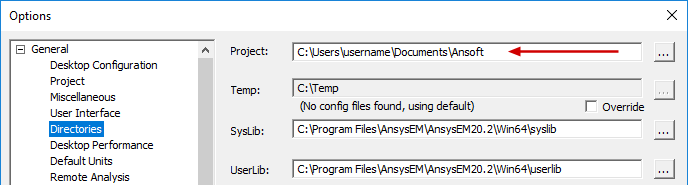
- The project directory of selected product: Save source project path relative to the default Project folder specified in the Options dialog box (Tools > Options > General Options):
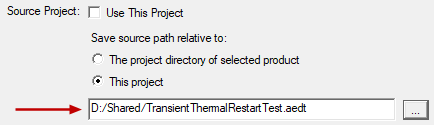
- This project: Save source project path relative to the target project location.
- Click the ellipsis button ( ... ) to the right of the Source Project text box.
- Locate the source project file and select it.
- Click Open
- Choose the Source Design and Source Solution from the provided drop-down menus:
- Optionally, select one or both of the following two options:
- Simulate source design as needed: Select this option if you want an updated solution to be linked to the target design when the source design has been modified.
- Preserve design solution: When the source design is in a separate project, and that project is closed, the source design will not be saved (preserving the preexisting solution data). This option has no effect if the source design is in the same project as the target design.
- Click the Variable Mapping tab.
- Optionally, to keep the source and target design variables synchronized, click Map Variable by Name. Then, the same variable names will appear in both columns, and the values will remain synchronized between the linked analyses.
- Source variables can only be mapped by name if they already exist in the target Mechanical–Thermal design. When you copy and paste the entire source design to create the target design, there is no concern. All geometry and non-geometry-related variables (such as a wattage specified in an excitation) will be present in both designs.
- When the Value Mapped to Source Design column contains constants, those constant values will be passed to the source design even if you change the associated variable's value in the target design's Properties dialog box (Mechanical > Design Properties) or in the docked Properties window (with the target design selected in the Project Manager).
- If you have not mapped the detected variables by name, you will be prompted with a warning upon attempting to close the Setup Link dialog box. The warning will allow you to return to the Variables Mapping tab to click the Map Variable by Name button. Alternatively, you can accept the unsynchronized variables and close the dialog box.
- Click OK to accept the link settings and close the Setup Link dialog box.
- Depending on which type of transient thermal restart scenario you are setting up, choose the appropriate link below to continue:
- Steady-State Thermal source design: Continue at step 7d of the Restarting from a Steady-State Thermal Solution topic.
- Transient Thermal source design: Continue at step 6d of the Restarting from a Separate Transient Thermal Solution topic.
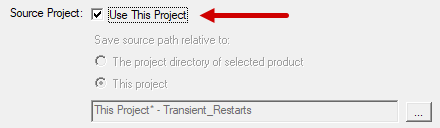
It is convenient to include source and target designs within the same project. Doing so keeps all project files in the same location and is the most convenient and straightforward way to organize linked designs. However, this approach may be impractical when there is a large number of designs in the project.
The Open dialog box appears.
The selected Source Project is listed in the Setup Link dialog box:

These two settings are automatically populated with an available design and solution in the source project. However, if more than one other design or solution exists in the source project, you can manually select the desired ones (if different from the automatically selected design or solution).
Certain changes to the source design may not invalidate its solution. In these cases, a new source solution will only be run if the previous one did not converge. To achieve convergence, you may have to increase the specified maximum number of iterations or relax the convergence criterion in the source solution setup.
If design variables have been defined in the source design, they are listed in the Variable from Source Design column. Initially, the nominal value of each variable is listed in the Value Mapped to Source Design column:
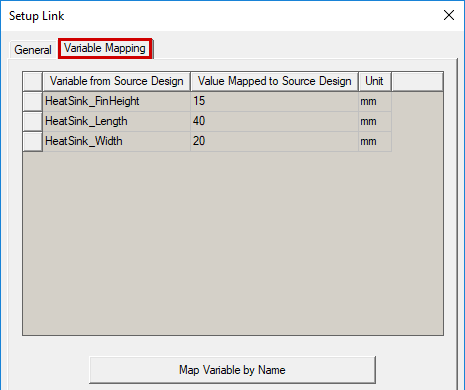
The values passed back to the source design from the mechanical design (second column) can either be constants (numeric values), variables, or expressions. The specified values determine the variation from which the source design provides the linked data.
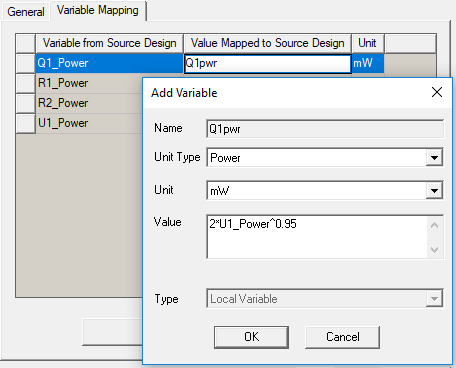
Automatic variable creation is supported in the Variable Mapping tab . You can directly type a new variable name into the Value Mapped to Source Design column, and the Add Variable dialog box will appear, in which you can define the Units and Value of the variable. The specified value can be a constant, a variable name, or an expression.
.png)
Mapping variables to the source design by name is useful for Optimetrics analyses (for cases where changing the value of a variable affects both the target and source designs). You can create an Optimetrics setup in the target design that sweeps both the target and source designs. However, a variable might be used only in the target transient design (for example, a dataset variable used to control an excitation or boundary over time). Whereas the source design might have used static boundaries and excitations. In such cases, variable mapping is not applicable.
If you later revisit the Thermal Solve Setup dialog box to verify or modify its properties, click the Setup Link button under the Advanced tab to return to the Setup Link dialog box. This dialog box will reopen in View Only mode. To modify the properties, first select the Edit Link radio button.