The Adaptive Analysis Process
An adaptive analysis refines the mesh in order to increase the precision and accuracy of the solution. When the Ansys Electronics Desktop (AEDT)TM electronics systems design platform performs an adaptive analysis, the process of computing a current solution is an iterative one. In general, you should first accept the default stopping and the default refinement criteria. Then, after you generate the chosen current solutions, check their convergence to see if the stopping criteria need to be adjusted.
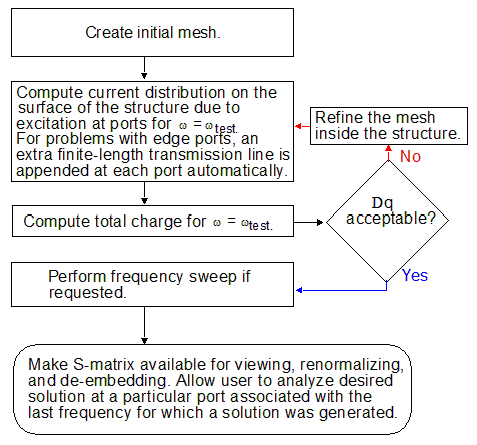
The adaptive frequency is converged when the Delta S for the frequency is reached and all the output variables have converged OR when the maximum number of passes for the frequency is reached. When either of those criteria have been reached, the adaptive refinement moves to the next frequency or stop, if there are no more frequencies. The mesh that has been refined at the end of one adaptive frequency are used as the starting mesh for the next adaptive frequency. The solution is refined in the following way:
- The Desktop generates a dense mesh at a fixed frequency, the frequency specified in the Frequency field.
- The Desktop computes the currents that exist inside the structure when it is excited at a single frequency, the frequency specified in the Adaptive Frequency field. If a frequency sweep is being performed, an adaptive analysis is performed only at the frequency specified in this box.
- A solution is generated on the computed currents.
- If the number of requested passes is satisfied or the target maximum delta norm is in the chosen range, the solution process stops. Otherwise, AEDT performs another iteration.
- The Desktop refines the mesh in the areas of highest error.
- Another solution is generated using the refined mesh. AEDT recomputes the error, and the iterative process (solve — error analysis — refine) repeats until the number of requested passes is satisfied or the target maximum delta norm is in the chosen range.
If a frequency sweep is being performed, AEDT solves the problem at the other frequency points without further refining the mesh.
The procedure for performing an adaptive solution is shown in the following figure: