
Loop Tree Discretization
The MPIE method is unstable at low frequencies. Each element of the MoM matrix comprises the impedance from an inductive term and a capacitive term. As the frequency moves toward zero, the impedance on the inductive term tends toward zero, while the impedance of the capacitive term tends toward infinity. This leads to numerical instability and poor results because the inductive term is lost in the numerical noise of the capacitive term.This can also be seen by breaking the MoM Z-matrix into sub-matrices S and T. The MoM matrix is

where w is the frequency. The sub-matrices treat the scalar and vector potential parts of the integral equation separately. The elements of the sub-matrices are

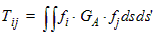
where fi and fj are the shape or basis functions. As the frequency w goes to zero, the MoM matrix reduces to S. The matrix S is nearly singular at very low frequencies; it corresponds to currents with nearly zero divergence.
The Ansys Electronics Desktop (AEDT)TM electronics systems design platform loop tree discretization is a re-ordering of the MoM matrix that explicitly preserves the vector potential part of the MoM matrix that corresponds to the inductance term. It thereby provides a highly stable solution at very low frequencies. At higher frequencies in which the MoM matrix impedances on the inductance and capacitance are on the same order, the loop tree discretization has little or no benefit, but it does not increase computation time or reduce accuracy.