
Adaptive Solution Process and its Importance to HFSS
HFSS uses the automatic adaptive mesh refinement process to solve an EM problem. Automatic adaptive mesh refinement is a critical part of the overall solution process and the key to producing accurate results. This meshing technique helps you focus on setting up your design efficiently rather than spending time in determining and creating the best mesh. To set up the design, you need only to create the geometry and specify material properties, boundary conditions, excitations, and the solution frequency.
Note: For more information about how to set up a design, see "Modeling Practice in HFSS".
In the adaptive mesh refinement process, the mesh is refined iteratively and is localized to regions where the electric field solution error is high. This iterative refinement technique increases the solution’s accuracy with each adaptive solution. The refinement process continues until HFSS converges to an accurate solution. Convergence is determined by monitoring a parameter from one adaptive pass to the next. The most common convergence criterion is to ensure that the difference in the S-parameter value between two consecutive solves is less than the specified magnitude.
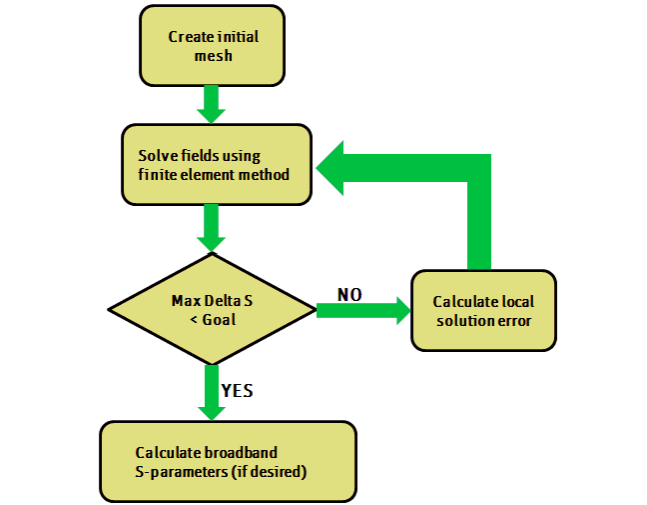
Simplified Flow Chart of Adaptive Refinement
The adaptive process can be summarized as follows:
- HFSS generates an initial geometrically conformal mesh.
- Using the initial mesh, HFSS computes the electromagnetic fields that exist inside the structure when it is excited at the solution frequency.
- Based on the current finite element solution, HFSS determines the regions of the problem domain where the exact solution has a high degree of error. A predefined percentage of tetrahedra in these regions is refined. The mesh is refined by creating a number of smaller tetrahedra that replace the original larger element.
- HFSS generates another solution using the refined mesh.
- HFSS recomputes the error, and the iterative process (solve -> error analysis -> refine) occurs until the convergence criteria are satisfied or the requested number of adaptive passes is completed.
Note: If a frequency sweep is being performed, HFSS solves the problem at other frequency points without further refining the mesh.
The above process creates an appropriate mesh for any arbitrary HFSS simulation ensuring an accurate result for a given simulation.
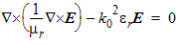
Mathematically, the error is computed along the following lines.
Let  be the solution to step 2 above. This value is inserted in the
following equation
be the solution to step 2 above. This value is inserted in the
following equation
|
|
|
(8) |
yielding
|
|

|
(9) |
For each tetrahedron in the mesh, the residue function is evaluated. A percentage of the tetrahedra with high residue values are selected and refined.
The following figures illustrate the automated adaptive mesh refinement solution process that is used by HFSS for the simulation of a patch antenna.
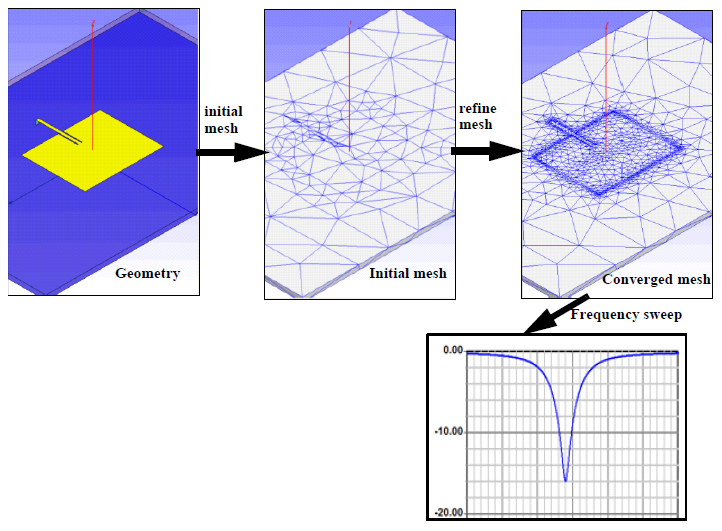
Adaptive mesh refinement example