Defining Anisotropic Tensors
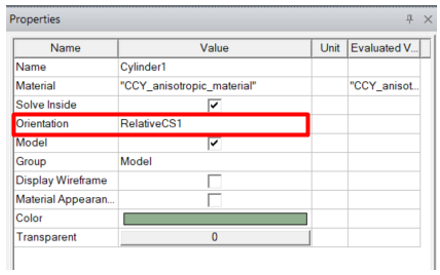
If a material property is anisotropic, its characteristics are defined by its anisotropy tensor. Each diagonal represents a tensor of your model along an axis. These tensors are relative to the coordinate system specified as the object’s Orientation property (when supported). Otherwise, the tensors conform to the global Cartesian coordinate system. By specifying different orientations, several objects can share the same anisotropic material but be oriented differently. Spherical and Cylindrical tensors must be converted to Cartesian coordinates, as described below. In such cases you must specify the coordinate system carefully.
Anisotropic materials are supported in 2D models but are not available for Q3D.
Assigning Anisotropic Tensors
To assign anisotropic tensors to
- From the View/Edit Material window, use the Type drop-down menu to select Anisotropic.
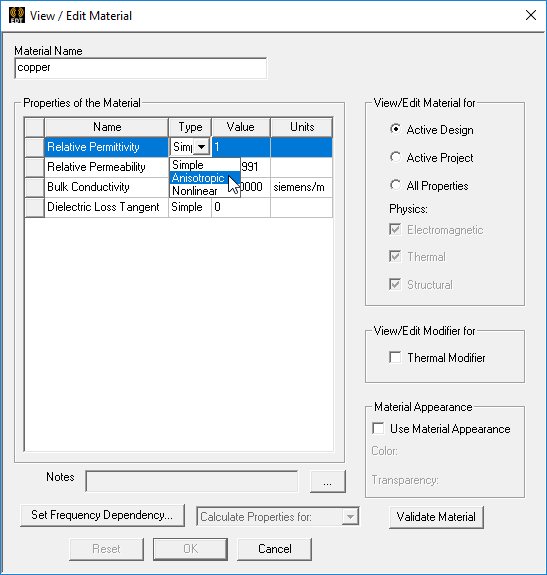
Two rows, labeled T(1,1) and T(2,2) appear, as shown below:
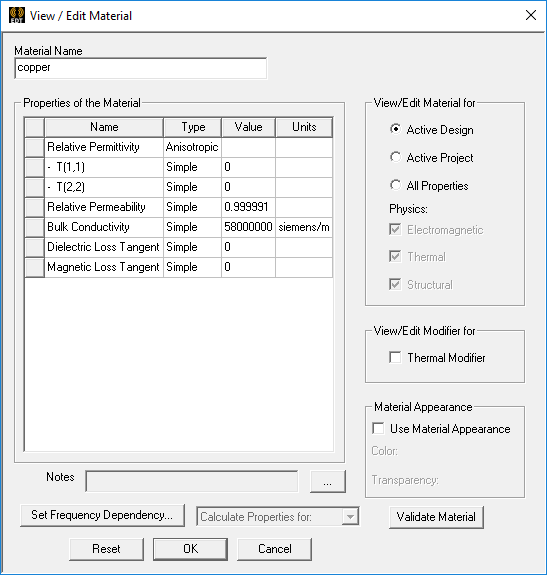
- For each of the new anisotropic property rows, use the Type drop-down menu to select either Simple or Nonlinear (when supported). This setting determines the type of Value you can enter.
- In the Value field, enter the
- For Relative Permeability – enter the relative permeability along each axis of the material’s permeability tensor. This can be a simple value, a variable, a constant, or a Nonlinear BH Curve.
- For Relative Permittivity – enter the material’s relative permittivity along each tensor axis. This can be a simple value or a variable. If the relative permittivity is the same in all directions, use the same Simple values for each axis.
- For Conductivity – enter the material’s conductivity along each tensor axis. This can be a simple value or a variable.
- For Dielectric Loss Tangent – enter the ratio of the imaginary relative permittivity to the real relative permittivity in one direction. This can be a simple value or a variable.
- For Magnetic Loss Tangent – enter the ratio of the imaginary relative permeability to the real relative permeability in one direction. This can be a simple value or a variable.
- Click OK to save the values and return to the Select Definition window.
Cylindrical Anisotropic Material Properties: Tensor Conversion from Cylindrical to Cartesian CS

where M is a transformation matrix.
Tensors, describing material properties, could be transformed accordingly as

If we assume only the diagonal components as non-zeros for the tensor in the Cylindrical basis
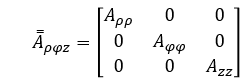
the resulting tensor in the Cartesian basis could be derived as

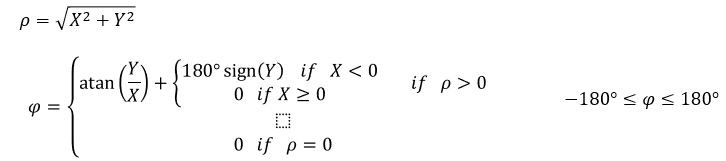
We should define and using X, Y and Z:
Related

First you create all required Project variables.
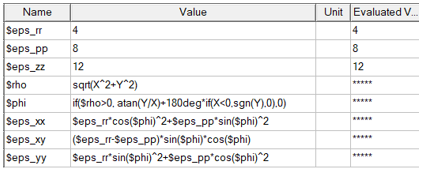
You can then use the variables to create the material.
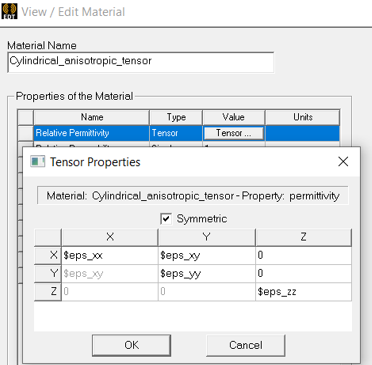
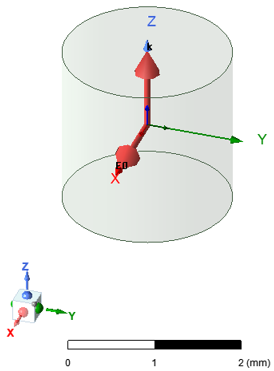
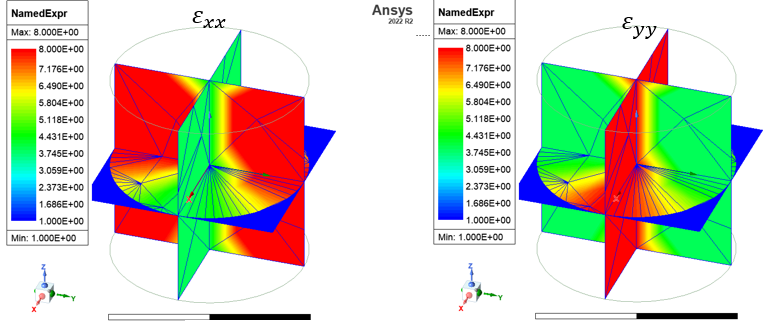
For the test case for cylindrical anisotropic material definition, using converted tensors based on variables:

For this problem type, consider that scattering on a cylinder where diameter and height are equal to 0.2 wavelength and a plane wave excitation along Z-axis.
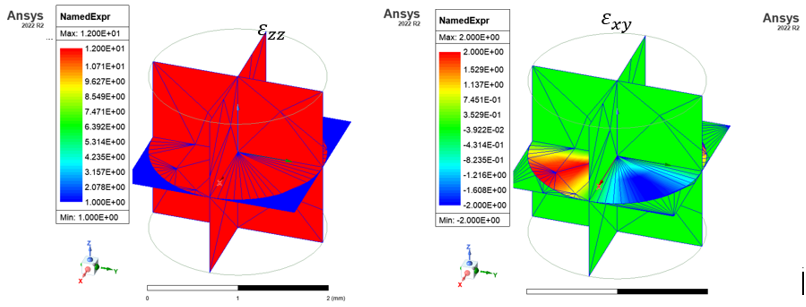
Spherical Anisotropic Material Properties: Tensor Conversion from Spherical to Cartesian CS

where M is a transformation matrix
Tensors, describing material properties, could be transformed accordingly as

We should define ρ,θ , and φ using X, Y and Z

Related
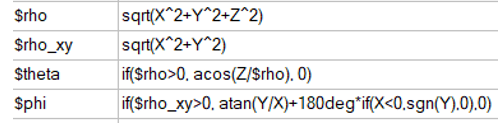
Note: the material characteristics close to the Z-axis could be slightly incorrect because of uncertainty of φ in the case of ρxy=0.
First you must create the necessary project variables.
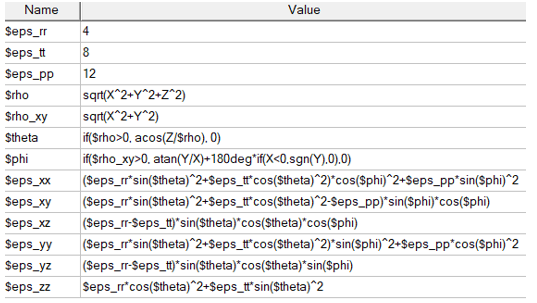
You can then use the variables to create the material.
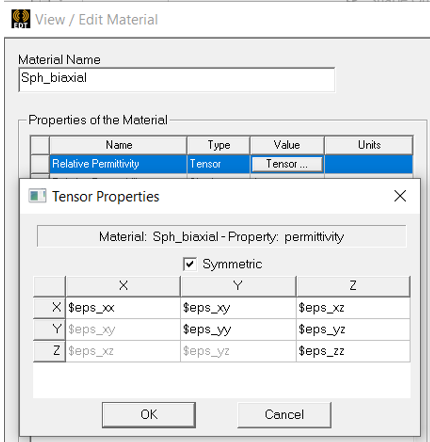
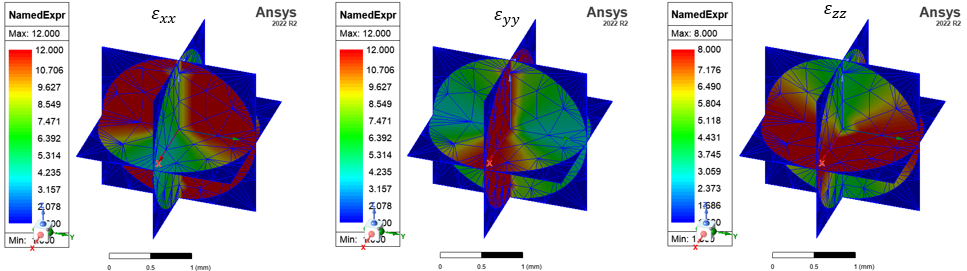
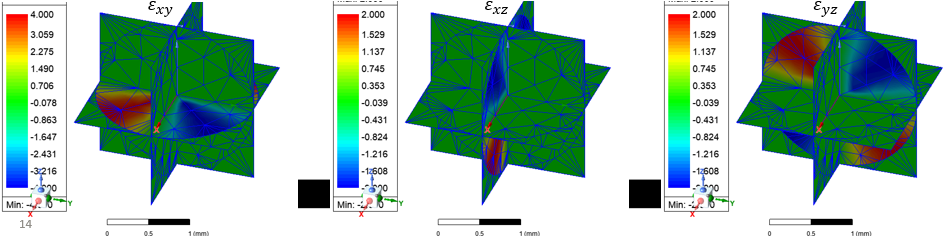
For the test case:

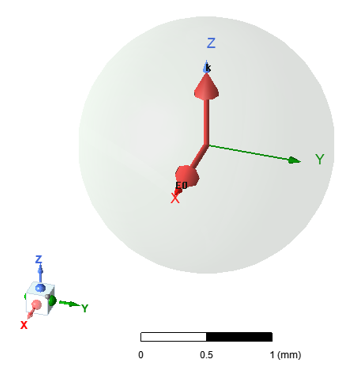
Problem type: scattering on a sphere(diameter is equal to 0.2 wavelength).
Plane wave excitation along Z-axis