
Units of Impedance Boundaries
Impedance on the surface of objects, Zs, has units of ohms per square. The units ohms per square indicate that the impedance, Zs, is equal to the equivalent circuit impedance, Z, measured between the edges of a square sheet of the material.
For example, a rectangle of length L and width w has a uniform current, I, applied to it. It has a voltage drop, V, across it and an equivalent circuit impedance of Z ohms.

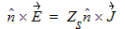
If the current density, J, is uniform over the rectangle then the equation (1)
|
|
|
(1) |
becomes equation (2)
|
|

|
(2) |
where
-
 on the rectangle, and
-
 on the rectangle.
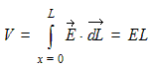
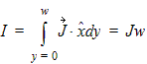
The circuit quantities and fields are related as follows:
|
|
|
(3) |
|
|
|
(4) |
|
|

|
(5) |
Substituting equation (1) into equation (5) results in the following equation:
|
|

|
(6) |
Thus, when L = w, the equivalent circuit impedance is equal to the impedance on one square. Hence the units ohms per square.
If in this example L = 2w, the impedance would be equal to one-half of the circuit equivalent impedance for the rectangle, or the circuit equivalent impedance of one "square" of the rectangle is equal to the impedance of that square. Therefore, when entering the surface impedance for an object, you must enter the impedance per square.