
Sin(x)/x Sampling Compensation
Due to discrete sampling, the transfer function of a digital process is altered by the sampling spectrum according to the following expression:
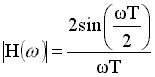
To maintain the frequency response of a digital process in light of this sampling corruption, it is necessary to alter the desired digital process by the inverse of the sampling frequency response according to the following expression:
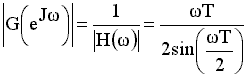
Sinx/x compensation
References:
Rabiner & Gold, "Theory and Application of Digital Signal Processing", 1975, pages 300, 301
Oppenheim & Schaffer, "Discrete Time Signal Processing", 1999, page 199
In reality, an approximate solution that is reasonably accurate up to half the sample rate is an acceptable solution. The following expressions provide this approximate accuracy:

The higher order expressions are more accurate than the lower order expressions. The FIR solution is slightly less accurate than the IIR solution, but is useful when the FIR characteristic of a filter must be maintained.
The table below shows the ideal correction, FilterSolutions IIR correction, and FilterSolutions FIR correction as a function of frequency.
|
Frequency |
Ideal |
IIR 1 |
IIR 2 |
IIR3 |
FIR 1 |
FIR 2 |
FIR3 |
|
Fs/10 |
1.02 |
1.02 |
1.01 |
1.02 |
1.04 |
1.01 |
1.02 |
|
Fs/5 |
1.07 |
1.09 |
1.07 |
1.06 |
1.12 |
1.06 |
1.06 |
|
Fs/3 |
1.21 |
1.25 |
1.22 |
1.21 |
1.25 |
1.24 |
1.22 |
|
2Fs/5 |
1.32 |
1.33 |
1.33 |
1.33 |
1.29 |
1.34 |
1.34 |
|
Fs/2 |
1.57 |
1.38 |
1.42 |
1.45 |
1.32 |
1.40 |
1.44 |
Where Fs is the sample rate = 1/T
When the Correct for Sinx/x box is checked in the digital selections box, the IIR or FIR Z transforms are automatically augmented by one of the sin(x)/x correction Z transforms above. The Order box selection determines first or second order augmentation. The effect of these corrections can be observed by viewing the magnitude frequency response up to half the sample rate of a high pass or band stop filter with and without the sin(x)/x correction.
Graphical Comparison
The graphs below show each sinx/x correction trace superimposed on the ideal correction. This will help determine which correction is best to use for the digital filter design. The sample rate is 20 Hz on all graphs below.
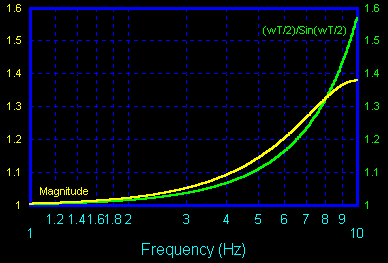
IIR First Order Correction

FIR First Order Correction

IIR Second Order Correction

FIR Second Order Correction

IIR Third Order Correction

FIR Third Order Correction