
Matched Filters
The Matched Filter is for use in communications. The distinguishing characteristic of a Matched Filter is the step response approximating a ramp, and the impulse response approximates a pulse. The purpose of the Matched Filter is to maximize the signal to noise ratio at the sampling point of a rectangular pulse and thereby minimize the probability of undetected errors received from a signal.
To achieve maximum signal to noise ratio, a Matched filter impulse response must be the time inverse of the shape of the pulse being sampled. Filter Solutions Matched filters are therefore only matched to rectangular shaped pulses.
Filter Solutions allows one to define the Matched Filter by setting the rise time of the ramp. The proper use of the matched filter is to set the rise time to be equal to the pulse width of the pulses in a bit stream.
The ideal matched filter step and impulse response are shown below. It is realizable with FIR filters. FIR Matched filters are also known as Moving Average filters.
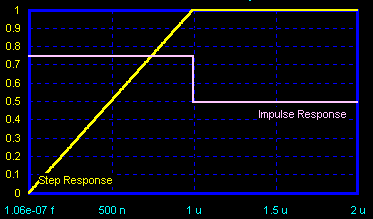
Ideal Matched Filter Time Response
Continuous Approximations of Matched Filters
Since ideal continuous and IIR matched FilterSolutions are not realizable, they must be approximated. FilterSolutions uses an approximate solution that optimizes the time response of the filter with the constraint that the transfer function zeros remain on the JW axis. Specifically, the integration of the square of the error between the filter impulse response and the ideal impulse response (a square pulse) is minimized under the mentioned restraint conditions. The purpose of the JW zeros constraint is to allow the filter to be realized with passive elements.
Excessively large doubly terminated and most singly terminated matched filters may produce negative passive element values and, therefore, are still not realizable with passive elements.
An example of a seventh order with minimum impulse error is shown below.
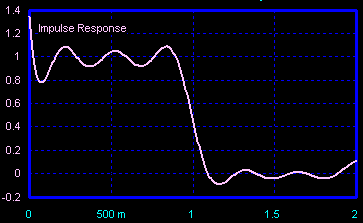
Continuous Matched Filter Approximation
Impulse Error
As expected the impulse error generally goes down as the order of the filter increases, but not always. Large odd order filters are more efficient than smaller even order filters.
The table below shown the integration of the square of the impulse error from zero to five pulse widths of a matched filter with a one second rise time.
|
Order |
Integration of the square of the impulse error
|
|
1 |
0.1932 |
|
2 |
0.1309 |
|
3 |
0.05975 |
|
4 |
0.05850 |
|
5 |
0.03397 |
|
6 |
0.03626 |
|
7 |
0.02354 |
|
8 |
0.02609 |
|
9 |
0.01795 |
|
10 |
0.02029 |
|
11 |
0.01449 |
|
12 |
0.01629 |
|
13 |
0.01221 |
|
14 |
0.01368 |
|
15 |
0.01064 |
|
16 |
0.01166 |
|
17 |
0.009349 |
|
18 |
0.01021 |
|
19 |
0.008332 |
|
20 |
0.009057 |