
About Diplexers
In the FilterSolutions Main Control Panel, the diplexer 1 option designs low pass/high pass diplexers, and the diplexer 2 option designs band pass/band stop diplexers or low pass, band pass, high pass diplexers, otherwise known as triplexers.
The basic diplexer consists of a high pass and a low pass filter, or a band pass and band stop filter in parallel that are driven from the same source and usually contains RC series tank elements in parallel to reduce undesired reflections.
The low pass and high pass legs, or the band pass and band stop legs of the diplexer are synthesized using normal low pass and high pass design parameters except that the reactive elements are calculated assuming a zero ohm source resistance. This is done to achieve a desirable reflection response, but slightly degrades the pass band frequency response. When an even order diplexer is specified, the highest frequency finite transmission zero is automatically mapped to infinity. The reflection zeros are left alone. Otherwise stated, the Even Order Mod option is automatically performed on the transmission zeros, but never on the reflection zeros.
When designing a low pass/high pass diplexer with stop band filters (Chebyshev II, Hourglass, or Elliptic filters) it is advantageous to use even order filters so that the number of inductors is minimized. Selecting "Asymmetrical" and entering an odd order high pass leg may further reduce the inductor count.
Contiguous Diplexers
Contiguous diplexers exist when the half power point (-3.01dB) frequency is the same for both legs of the diplexer. If the pass band ripple is set properly, all reflections will be below -20dB and no reflection compensation elements are needed. To create contiguous diplexers, uncheck the "Standard Pass Band Atten" checkbox, enter -3.01dB as the pass band attenuation. For high/low pass diplexers, set the bandwidth to zero. For band pass/stop diplexers or triplexers, set the outer bandwidth equal to the inner bandwidth.
Noncontiguous Diplexers
If a separation in frequency exists between the diplexer legs, a noncontiguous diplexer is created. Undesirable reflection may occur near the cutoff frequencies of the legs. Reflection compensating elements may be needed to force the reflections into the frequency gap between the legs and away from the frequencies passed by the diplexer legs.
The values of the compensation elements may be calculated by:
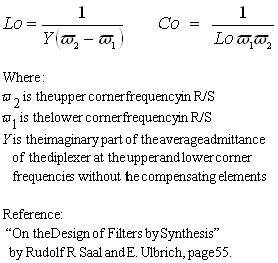
If a band pass/band stop diplexer or a triplexer is designed, two compensators are used, one for each frequency transition.
Triplexers
Triplexers are just like diplexers, except they have three legs instead of two, a high pass, low pass and band pass. Two reflection compensators are required, one for the low pass to band pass gap, and one between the band pass and high pass gap. The two gap center frequencies are the geometric mean of the arithmetic width of the gap.
Band Pass Diplexers
Diplexers composed of two band pass legs may be synthesized by selecting "Diplexer 1" and "Band Pass" in the Diplexer Type selection box. FilterSolutions will create three reflection compensator circuits, one for the center frequency, one above the upper band pass, and one below the lower band pass. The two outer frequency compensators are physically drawn on the diplexer legs, and are installed or removed as desired with the use of the "Compensate" selection on top of the diplexer schematic. The two center frequencies are the geometric mean of the arithmetic width of the respective band pass filters.
The center compensator conforms to the above defining equations. The outer compensators are approximations designed to minimize the reflections from the outer frequency portions of the band edges. Sometimes manual manipulations of the outer compensating elements may help improve band edge filter performance.
Diplexer Example, Low Pass/High Pass
An example of a diplexer is shown below. Only the compensator is shown, but it is composed of a 30MHz low pass filter in parallel with a 40Mhz high pass filter and has a parallel compensator. The rule of thumb is to keep the reflections outside the middle frequencies (30 to 40 MHz in this case) at least -20dB down. To achieve low reflections, it is generally necessary to set the pass band ripple to 100mdB or lower. If negative elements are generated in the diplexer, raise the dB of the pass band ripple until all elements are positive.
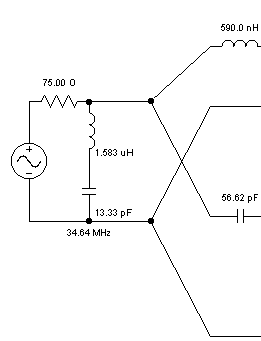
Low Pass/High Pass Diplexer Reflection Compensation
Without the parallel compensator, this circuit would contain undesirable reflections that do not meet the -20dB rule as shown here.
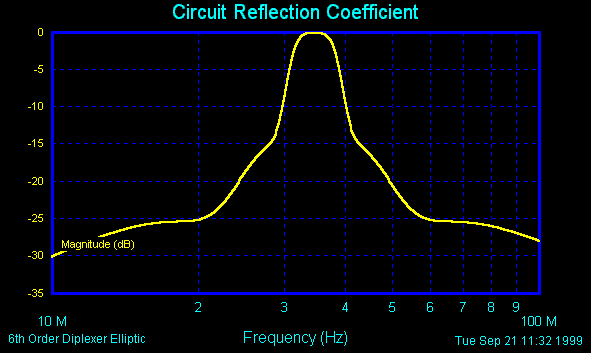
Uncompensated Reflections
With the parallel compensator, this circuit contains much more desirable reflections that are well below -20dB outside the middle frequency area.
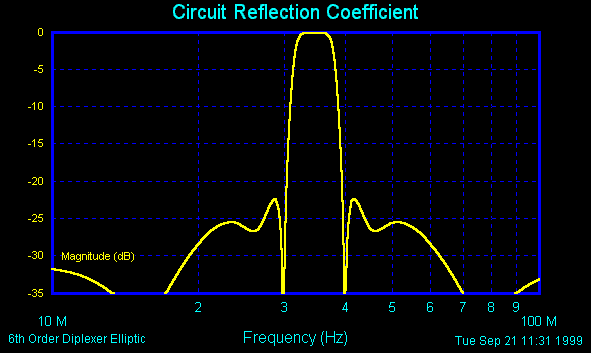
Compensated Reflections
Diplexer Example, Band Pass/Band Stop
An example of a band pass/band stop diplexer is shown below. The upper leg is a band pass filter, and the lower is a band stop filter. There are two reflection compensators, one for the low break frequency, and one for the high break frequency. The computation of the compensator element values is, however, the same as for low pass/high pass diplexers. In the case of triplexers, all computations are the same, except three legs exist to compute the compensation elements instead of two.
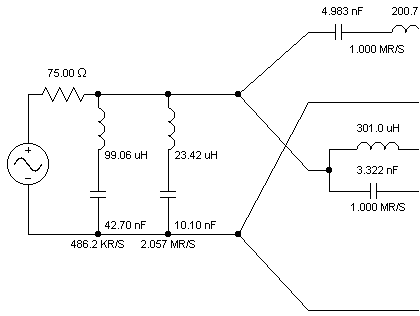
Band Pass/Band Stop Diplexer Reflection Compensation
Diplexer Example, Band Pass
Band pass diplexers may be defined by the band widths of the inner and outer corner frequencies respectively (Band Pass 1 Selection) or by the center frequency and band widths of each band pass leg (Band Pass 2 selection.)
An example of a band pass diplexer is shown below. Both legs of the diplexer are band pass filters. The leading reflection compensator is the center frequency. The leading parallel LC tank circuits on each leg are outer frequency reflection compensators.
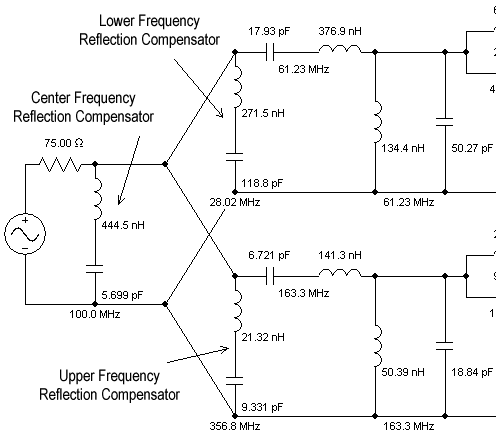
Band Pass Diplexer Example