Introduction
This example builds on the project developed in Tutorial 1 to introduce additional modeling concepts and features in EMIT. You can find a completed version of the Tutorial 1 project in the installed examples directory by clicking on Open Examples in the Desktop ribbon toolbar.

Key Concepts
- Building and analyzing scenarios with multiple Tx’s and Rx’s
- EMIT’s N-on-1 analysis mode
- Outboard amplifiers
- Interference due to intermodulation effects
Project Configuration
For this example, we will again modify the project built in Tutorial 1. Load that project into EMIT and save it as “Tutorial 3” by selecting Save As from the File menu.
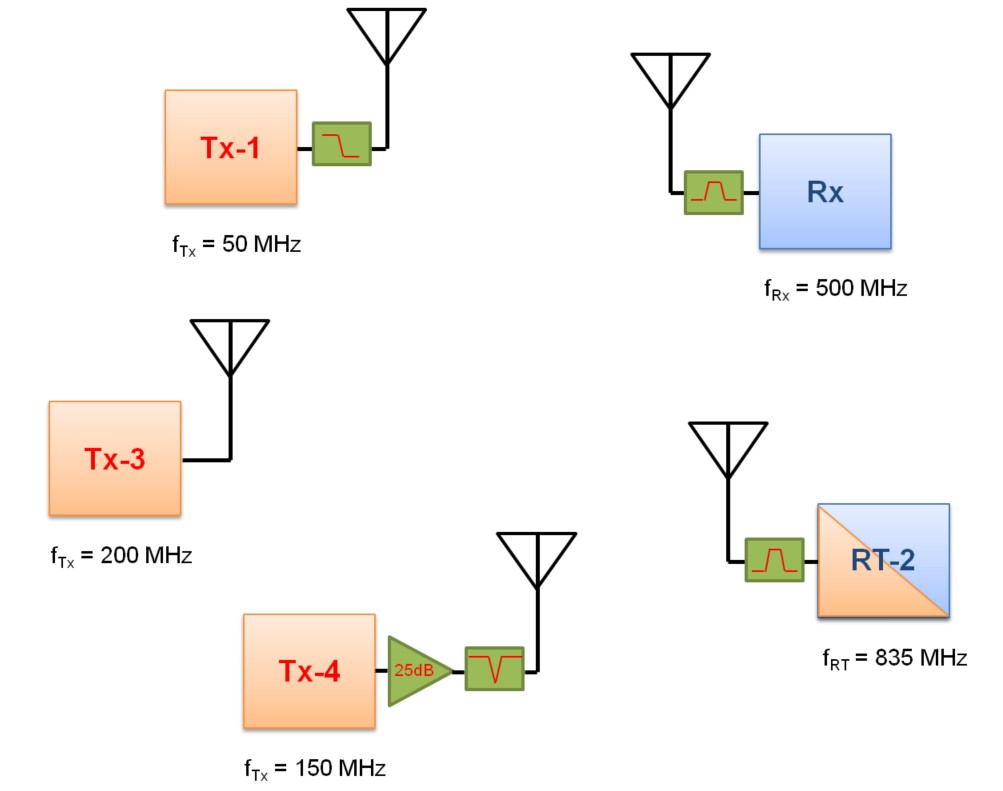
We will be adding several additional RF systems to this project and examining the effect of multiple Tx’s operating simultaneously and their effect on a victim Rx. Along the way we’ll explore various mitigation strategies to combat interference, eventually arriving at a completely interference-free scenario. The final scenario is shown notionally in the figure below. Note that since we are still using a fixed value (Global Default Coupling = -40 dB in this case) of coupling between all antennas, the actual physical location of the antennas is irrelevant (Tutorial 4 explores EMIT’s other antenna-to-antenna coupling models).
Up until now we have only looked at the effects of a single Tx on a Rx. When we look at multiple, simultaneously operating Tx’s on a victim Rx, we not only have to account for the direct signal from each Tx combining at the Rx antenna, but also the effects of inter-Tx coupling – that is, of signals coupling between the Tx’s and re-radiating to the victim Rx. This is of concern because when multiple signals couple into the front-end of a Tx, nonlinear effects in the Tx’s power amplifier (PA) can generate undesired intermodulation products that can cause interference even when the individual signals do not. We will see this first-hand during this example.