
Tunable Band Stop
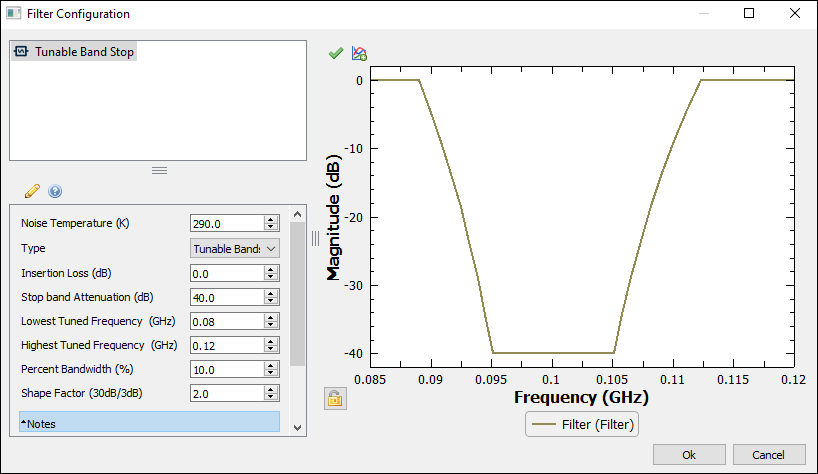
Defines a tunable band stop filter with the parameters shown in the configuration window above. A tunable band stop filter passes frequencies in the pass bands with minimal attenuation and rejects (attenuates) signals outside of the pass bands. A tunable band stop filter will pass both low and high frequencies and attenuate a specific band of frequencies as seen below in the plot of a band stop filter in EMIT. A band stop filter can be thought of as a low pass filter and a high pass filter cascaded together with a portion of their stop bands overlapping. In essence, a band stop filter has two pass bands. A band stop filter is sometimes referred to as a notch filter.
Tunable band stop filters are defined in terms of a tuning range and a percent bandwidth. For each channel within a transceiver, the spectral profile of the tunable filter will be recreated. For example, assume a transmitter is defined that operates from 100-110 MHz in 2 MHz channels and the filter has a 10% bandwidth. When EMIT is simulating the 100 MHz channel, the filter is centered at 100 MHz with a bandwidth of 10 MHz (red). For the 102 MHz channel, the filter is centered at 102 MHz with a 10.2 MHz bandwidth (blue). For the 110 MHz channel, the filter is centered at 110 MHz with an 11 MHz bandwidth (green). This is illustrated in the plot below.
When a transceiver is operating at a different frequency for transmit than for receive (e.g. for self interaction with a Tx Offset), the tunable filter always tunes based on the transmit channel frequency.
Noise Temperature (K): Noise power added by the filter.
Insertion Loss: Insertion loss defines the magnitude by which pass band signals are attenuated and is specified in dB. The pass bands of the band stop filter are defined as all frequencies that are below the lower cutoff frequency and above the higher cutoff frequency.
Stop Band Attenuation: Stop band attenuation defines the magnitude of the attenuation for signals with frequencies above the lower stop band frequency and below the higher stop band frequency.
Lowest Tuned Frequency: The lowest tuned frequency defines the lower end of the tuning range for the filter. If any Tx and/or Rx channels are defined below this frequency, then the filter will be centered at the lowest tuned frequency, rather than at the channel frequency.
Highest Tuned Frequency: The highest tuned frequency defines the higher end of the tuning range for the filter. If any Tx and/or Rx channels are defined above this frequency, then the filter will be centered at the highest tuned frequency, rather than at the channel frequency.
Percent Bandwidth (%): The percent bandwidth defines the the bandwidth of the filter stop band (notch) with respect to the center frequency of the filter.
Shape Factor: The shape factor describes the roll-off of the filter between the 3 dB and 30 dB bandwidth points.