
Tx Spectral Profile
The Tx Spectral Profile completely defines the broadband emission spectrum for each channel within the Band. Each channel in a Band shares the same operating parameters. However, different Bands for a single radio may have different operating parameters. The spectra that EMIT computes are based on the parameters supplied for the Bands and are referred to as parametric channels.
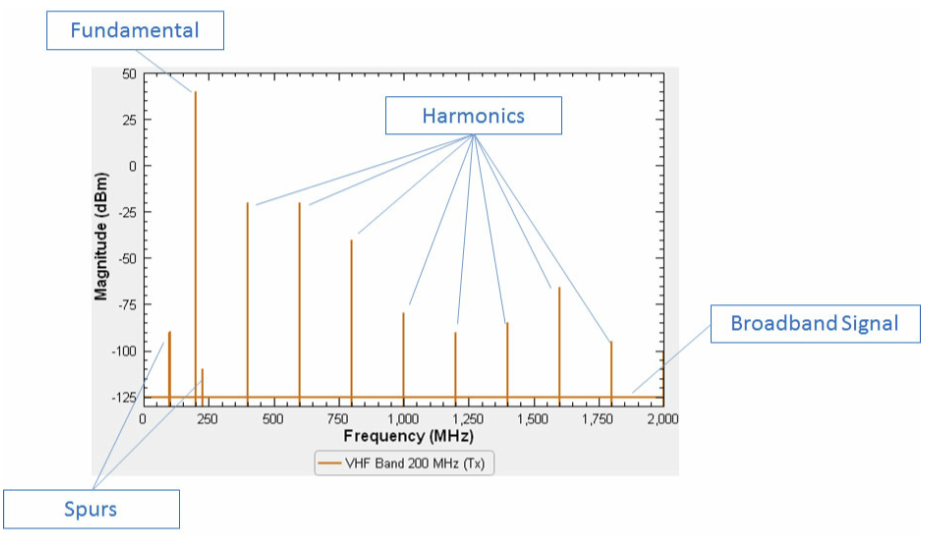
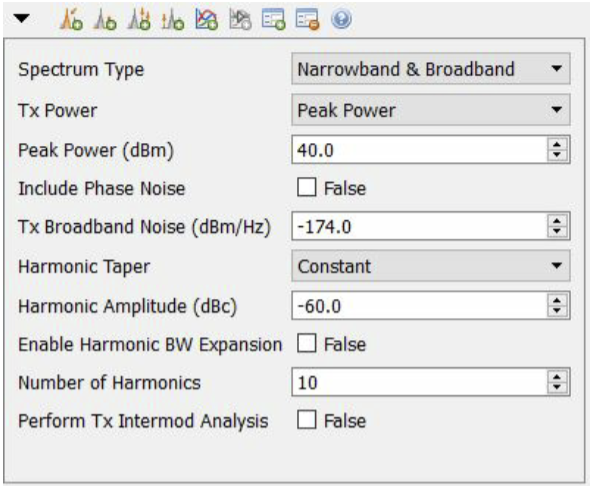
Spectrum Type: As shown in the plot above, a Tx Spectral Profile generally consists of both narrowband signal components (fundamental, spurs & harmonics) and a broadband signal component. In some cases, however, it may be desired tomodel a Tx Spectral Profile with only a broadband signal component. For example,an emitter that is characterized by a wideband noise density profile. This setting selects whether to include narrowband signal components in the Tx Spectral Profile.
Narrowband & Broadband
Tx Spectral Profile includes both narrowband and broadband components. The narrowband signal characteristics are defined by the Tx Spectral Profile properties and optionally by adding a Narrowband Emissions Mask, Custom Tx Harmonics and/or Spurious Emissions to the Tx Spectral Profile. Each of these appear in the configuration tree as children of the Tx Spectral Profile node. The frequency dependence of the broadband signal can be defined by adding a Broadband Noise Profile to the Tx Spectral Profile.
Broadband Only
Tx Spectral Profile includes a broadband only signal component. The frequency dependence of the Broadband signal can be defined by adding a Tx Broadband Noise Profile to the Tx Spectral Profile.
Tx Broadband Noise: The amplitude of the radio's broadband power density spectrum. Tx broadband noise levels are specified in terms of dBm/Hertz. The average power level of the broadband noise should be input here. EMIT will then compute the peak broadband noise level within a receiver's tuned channel when calculating the EMI Margin. The minimum broadband noise in EMIT is limited to the thermal noise floor of a 50-ohm system at room temperature which is -174dBm/Hz. Values smaller than that cannot be entered here.
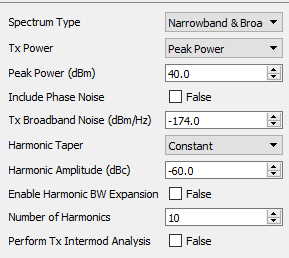
Tx Power: This setting determines whether the Tx power will be specified as Peak Power or Average Power for the current Tx Spectral Profile for modulation types that are specified in terms of power. For some modulation types, the amplitude is specified instead as a peak voltage as shown below, in which case this setting will not be present in the Tx Spectral Profile property panel. Note: The Tx power specified here is the power at the output of the Tx antenna port and includes any gain specified when Perform Tx Intermod Analysis is enabled.
Peak Power: The peak power of the fundamental (carrier) in dBm.
Average Power: The average power of the fundamental (carrier) in dBm.
Include Phase Noise: Enable/disable phase noise in the broadband noise model of the transmitter spectrum. The phase noise decreases by 20 dB/decade.
Tx Broadband Noise: The amplitude of the radio's broadband power density spectrum. Tx broadband noise levels are specified in terms of dBm/Hertz. The average power level of the broadband noise should be input here. EMIT then computes the peak broadband noise level within a receiver's tuned channel when calculating the EMI Margin. The minimum broadband noise in EMIT is limited to the thermal noise floor of a 50-ohm system at room temperature which is -174dBm/Hz. Values smaller than that cannot be entered here.
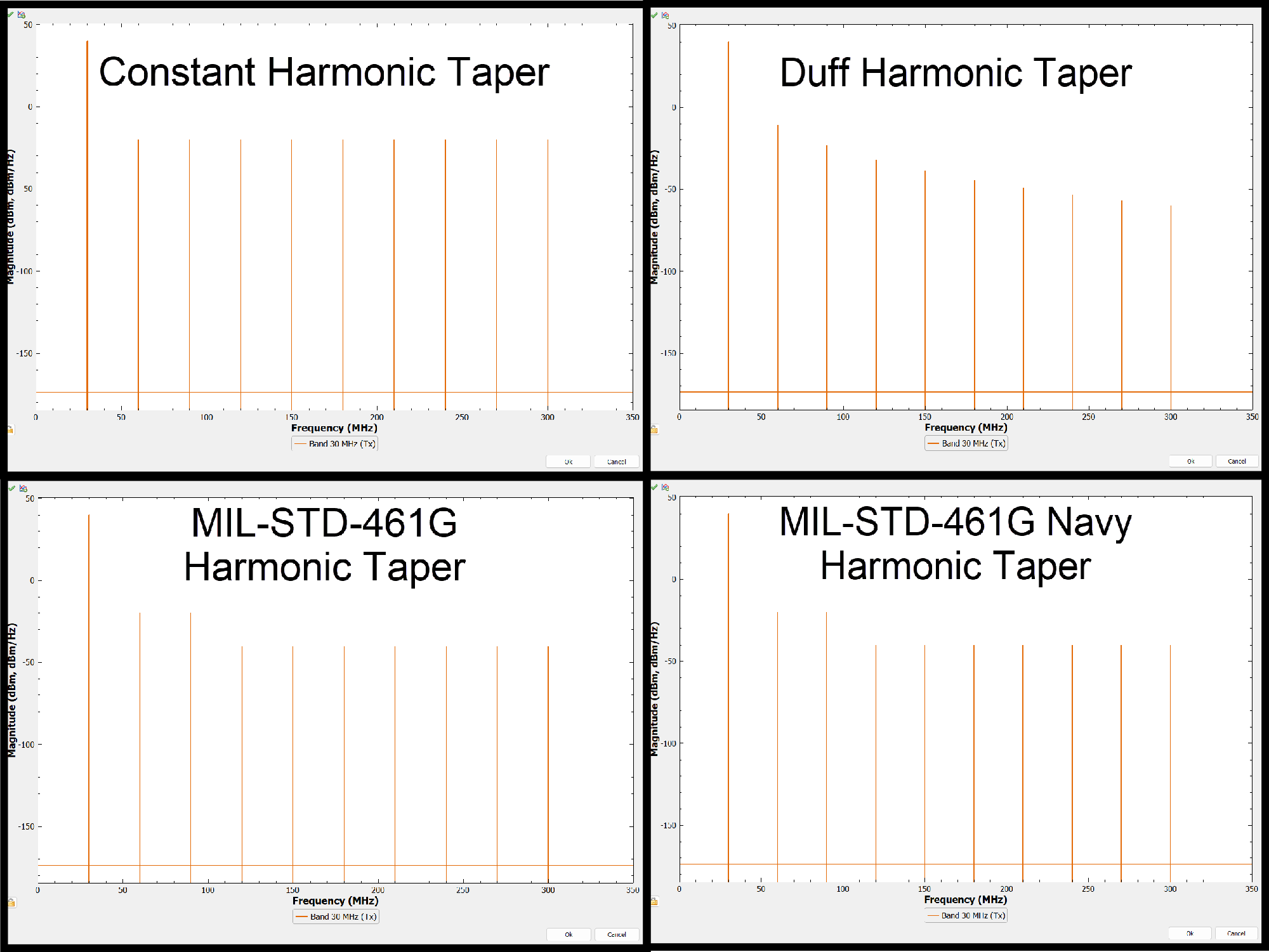
Harmonic Taper: EMIT offers several tapers that can be optionally applied to the Tx Spectral Profile's harmonics. The tapers determine the amplitude of each of the harmonics. The MIL-STD-461G model applies the limits defined in MIL-STD-461G to the harmonic amplitude levels. The MIL-STD-461G Navy model applies the limits defined in the standard for Navy shipboard applications. The Duff Model determines the amplitude level of the Nth harmonic based on:

where:
- Pn-th = average power in dBm at the Nth harmonic
- Pfo = fundamental power in dBm
- N = harmonic number
- A,B = constants derived from a transmitter statistical analysis where:
- A corresponds to the slope in dB per decade, and
- B corresponds to the amplitude intercept at the fundamental in dB above fundamental
Harmonic Amplitude: The amplitude of harmonics located at integer multiples of the channel frequency. All harmonics are initially set at this level and can be changed individually by adding Custom Tx Harmonics from the Tx Spectral Profile menu. Harmonic levels are specified in terms of dB relative to the carrier (dBc). Note that Harmonic Amplitude is only visible when the Harmonic Taper is set to Constant.
Enable Harmonic BW Expansion: By default, EMIT sets the bandwidth of each harmonic to be the same as the fundamental bandwidth. When Enable Harmonic Bandwidth Expansion is enabled, EMIT will instead set the harmonic bandwidths equal to the harmonic number times the fundamental bandwidth. That is, the second harmonic bandwidth will be twice the fundamental bandwidth, the third harmonic bandwidth will be three times the fundamental bandwidth, etc.
Number of Harmonics: The number of harmonics (including the fundamental) included in the Tx Spectral Profile computed by EMIT. Since this includes the fundamental, the number of harmonics in the spectral profile is one less than this setting. Note that by this convention, the Nth harmonic has harmonic order (N+1).
2nd Harmonic Level (DD-1494 Mode Only): The amplitude of the 2nd harmonic of the channel frequency specified in terms of dB relative to the carrier (dBc).
3rd Harmonic Level (DD-1494 Mode Only): The amplitude of the 3rd harmonic of the channel frequency specified in terms of dB relative to the carrier (dBc).
Other Harmonic Level (DD-1494 Mode Only): The amplitude of the higher order harmonics of the channel frequency specified in terms of dB relative to the carrier (dBc).
Perform Tx Intermod Analysis: When enabled (True), this feature includes a nonlinear amplifier internal to the radio. The amplifier is included only for the current Band and different amplifiers can be specified for different Bands of a single Radio. This feature permits a radio's nonlinear amplifier characteristics to be included in the radio mode.
The Tx Internal Amplifier is designed to model the nonlinear effects of the transmitter's front end on external signals that are incident on the Tx port. The characteristics of this Band's transmitted spectrum are entirely defined by the above parameters (e.g. Peak Power, Harmonic Amplitude, Broadband Noise, etc.) and are not impacted by the specifications of the internal amplifier. However, the narrowband components comprising the transmitted spectrum will mix with the external signals that are incident on the Tx port. These external signals will also have the internal amplifier's specifications applied including the reverse isolation and gain of the amplifier. Note that unlike the outboard amplifier, the Tx internal amplifier is modeled with an infinite bandwidth and thus there is no "filtering" applied to the mixed and reflected spectra.
It is important to understand that when modeling internal Tx amplifiers when using this option, the amplifier is treated as being active only for channel combinations that include the Tx using the internal amplifier. What this means is that if a single RF System contains multiple Tx ports with internal amplifiers, then only one amplifier within that RF System will be active at any one time with the active amplifier corresponding to the Tx channel included in the channel combination being simulated. Another way to state this is if you pick a channel combination in an N-to-1 simulation, there will only be N internal amplifiers treated as active. Those are the N amplifiers with the ports associated with the N Tx channels.
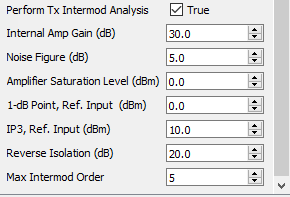
Internal Amp Gain: Define the in-band gain of the amplifier in dB.
Noise Figure: The amplifier's noise figure in dB. The noise figure is used to calculate the broadband noise added by the amplifier
Amplifier Saturation Level: Specifies an input power level for which EMIT will consider the amplifier saturated. When an amplifier is saturated, EMIT flags it as such in the results and does not trace the input signal any further. The saturation level cannot be set lower than the 1-dB Point.
1-dB Point Ref. Input: The amplifier's 1-dB compression point referred to the input of the amplifier.
IP3, Ref. Input:The amplifier's third order intercept point referred to the input of the amplifier.
Reverse Isolation: This is the amplifier's reverse isolation. The reverse isolation of an amplifier is a measure of how well a signal applied to the amplifier's output is "isolated" from its input. It is equivalent to the S12 S-parameter.
Max Intermod Order: Specifies the highest order of intermodulation product that EMIT will calculate for the amplifier.