
Low Pass
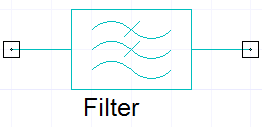
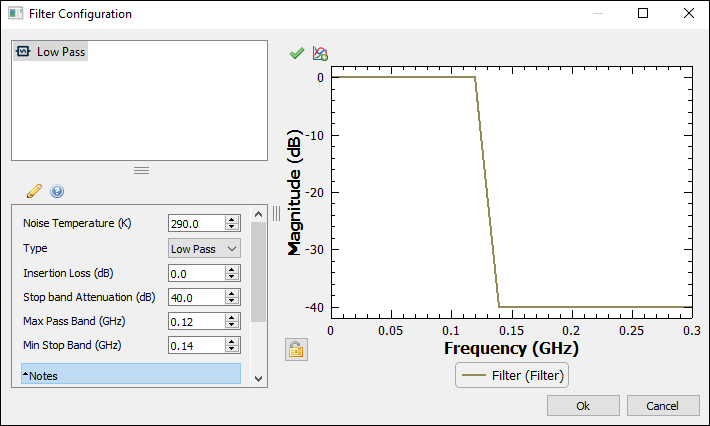
Defines a low pass filter with the parameters shown in the configuration window above. A low pass filter passes low frequency signals with minimal attenuation and attenuates (reduces the amplitude of) signals above the cutoff frequency. Also shown is a plot of a low pass filter in EMIT.
Noise Temperature (K): Noise power added by the filter.
Insertion Loss: Insertion loss defines the magnitude of the attenuation of signals in the pass band and is specified in dB. The pass band of the low pass filter is defined as all frequencies from DC up to the maximum pass band frequency.
Stop Band Attenuation: Stop band attenuation defines the magnitude of the attenuation for signals with frequencies greater than the minimum stop band frequency. The attenuation of signals with frequencies between the maximum pass band frequency and the minimum stop band frequency is determined by calculating the slope between these two points and assuming a linear roll-off.
Max Pass Band: The max pass band defines the maximum frequency of the pass band which is also commonly referred to as the filter's cutoff frequency.
Min Stop Band: The min stop band defines the lowest frequency of the stop band. All frequencies above the min stop band value are attenuated by an amount equal to the stop band attenuation.