
Virtual EMI Receiver Probe
This FFT-based (i.e., Fast Fourier Transform) virtual EMI receiver (i.e., Time Domain Scan) probe reduces EMI/EMC compliance test time, allowing users to verify their designs with shorter bench and chamber time.
The virtual EMI receiver functions with the following major steps for EMI/EMC compliance tests:
Transient signal mixed with EMI noise of DUT (Device Under Test) first undergoes Short-Time-Fourier-Transform (STFT) analysis with Gaussian Window () to output 3D Spectrogram data which shows frequency component change in the signal with respect to time. Then the Spectrogram data is passed through the desired EMI detectors to obtain signal strength (e.g., dBmV) in the selected frequency range. Users can apply limit lines defined according to various standards (e.g., CISPR25 for automobile tests, IEC 61967 for IC circuits), to analyze if the DUT data passes EMC testing.
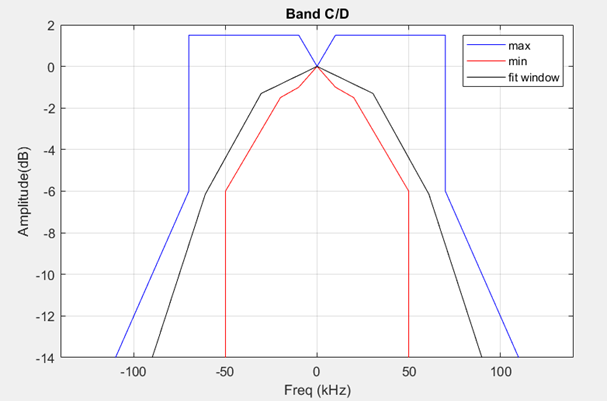
The accuracy of the virtual EMI receiver is dependent upon the length of signal (time duration), of Gaussian window, window length, size of FFT, and the overlap rate of windows during calculation of STFT. CISPR 16-1-1 defines the band pass selectivity requirement of the Gaussian window for each band. Resolution bandwidth (RBW) is the bandpass width at 6dB below peak of a Gaussian window.
| Characteristics | Frequency Band | ||
| Band A (9 kHz to 150 kHz) | Band B (0.15 MHz to 30 MHz) | Band C and D (30 MHz to 1,000 MHz) | |
|
Bandwidth at the -6 dB points (kHz) |
0.20 | 9 | 120 |
| Detector electrical charge time constant (ms) | 45 | 1 | 1 |
| Detector electrical discharge time constant (ms) | 500 | 160 | 550 |
The following figure demonstrates a Gaussian window that successfully fits within the tolerance defined in CISPR 16-1-1 for Band C and D.
RBW affects EMI receiver’s ability to resolve closely spaced signals. Two narrow signals can only be separated, if the resolution bandwidth is smaller than the distance between these two signals. RBW also determines the noise floor of the detected spectrum. Larger RBW results in higher measured noise floor because more frequency components can pass through a wider RBW filter for various detectors.
RBW Factor is added to provide choices for number of frequency samples per RBW. The number of frequency samples per RBW = 1/’RBW Factor’, i.e., 4 samples per RBW when RBW Factor = 0.25. Frequency step size of the EMI receiver is equal to ‘RBW’ * ‘RBW Factor’. Similar to smaller RBW, more samples per RBW lead to a more accurate representation of the signal and lower detection noise floor. It’s common practice to have 2 to 4 samples per RBW in EMI receivers to ensure adequate sampling and resolution of the signal.
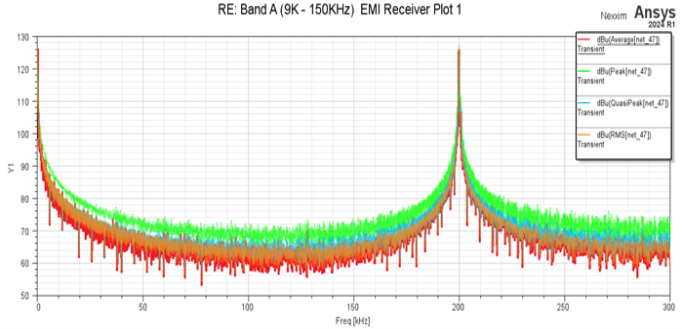
Examples of detected EMI signals are shown below with P, QP, RMS and Ave detectors.
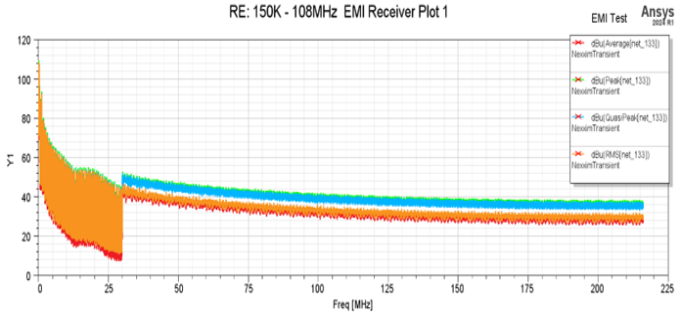
When a Band includes multiple CISPR16 Bands and mixed RBW values are used, detected EMI signals show steps in noise level due to RBW value change. The following is an example plot for Band 150K-108MHz(RBW = 9KHz is applied for frequency range from 150K to 30M, and RBW=120K is used for 30M-108MHz):
By default, Gassian parameter sigma, the size of the FFT, and the window size is automatically set to meet the band pass selectivity requirements defined in CISPR 16-1-1. When the signal length is less than the window size appropriate for the chosen RBW and RBW Factor, only single FFT can be applied to the available signal. In such case, EMI receiver results for all detection methods would be on top of each other based on the single FFT. Smaller RBW or RBW factor requires larger window size, hence longer transient signal for effective EMI analysis. The following table provides reference signal length for each CISPR16 band to accommodate available RBW factor settings. Note that these signal lengths do not take into account the QP detection time constants for each band, which demand much longer signals.
| RBW | Signal Length | |||
| Band A | 200Hz | > 25ms | ||
| Band B | 9KHz | > 555us | ||
| Band C/D | 120KHz | > 42us | ||
| Band E and above | 1MHz | > 5.3us |
The virtual EMI receiver supports four types of detectors defined in CISPR 16-1-1 (i.e., Average, Peak, Quasi-Peak (QP) and RMS).
-
Average computes the average signal over time
-
Peak saves the maximum signal value over time at each frequency point
-
QP provides weighted signal magnitude at each frequency point; component signals with a high repetition rate are weighted more than rarer signals
-
RMS computes root-mean-square signals over time at each frequency point.
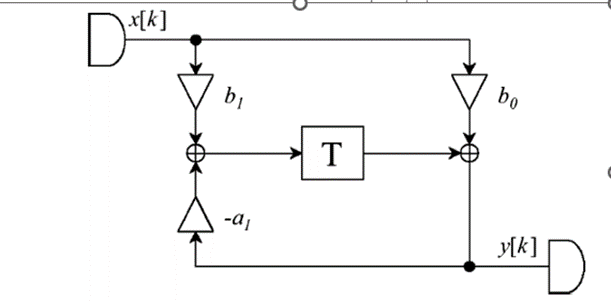
To achieve accurate QP results with large time constants, about 1 second of simulated signal is required. To overcome this limitation, as long as the signal length is 2.2 x charge time (rise to 90% of signal strength), the IIR filter structure is used to compute QP. Otherwise, a simplified estimate of QP detection is applied. Due to these assumptions, QP results should be used with consideration unless the signal is long enough to support the required time constants. The result of Peak and RMS detections provides upper and lower bounds for QP detection.